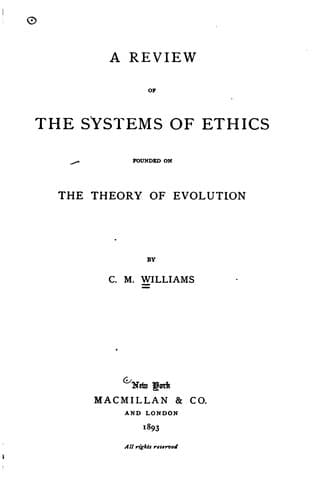
A Review of the Systems of Ethics Founded on the Theory of EvolutionWilliams, Cora May
Philosophy
A Review of the Systems of Ethics Founded on the Theory of Evolution
Williams, Cora May
Ethics, Evolutionary
More clearly in the case of human beings than in that of other animals
is it shown that gregariousness establishes itself because it profits
the variety. Where a variety live on wild food, they associate only in
small groups; game and fruit, widely distributed, can support these
only. "But greater gregariousness arises where agriculture makes
possible the support of a large number on a small area; and where the
accompanying development of industries introduces many and various
cooeperations." The advantages of cooeperation can be had only by
conformity to the conditions which association imposes--by such
limitation of the pursuits of individuals as to leave a surplus of
advantage to associated life. "This truth is illustrated by the
unprosperous or decaying state of communities in which the trespasses of
individuals on one another are so numerous and great as generally to
prevent them from severally receiving the normal results of their
labors." Mutual restraint being more imperative with human beings than
with animals, there is with them a still more marked habit of
punishment.
"Through all which sets of facts is manifested the truth, recognized
practically if not theoretically, that each individual, carrying on the
actions which subserve his life, and not prevented from receiving their
normal results, good and bad, shall carry on these actions under such
restraints as are imposed by the carrying on of kindred actions by other
individuals, who have similarly to receive such normal results, good and
bad. And vaguely, if not definitely, this is seen to constitute what is
called justice."
In the highest gregarious creature, the necessity which we found, of an
occasional sacrifice of the individual in defence of species, assumes
large proportions, the defence being not only against enemies of other
kinds, but also against enemies of the same kind. This obligation is
less than that of care for offspring, or mutual restraint. It exists
only as necessary to protect the society against destruction, hence only
for defensive, not for offensive, war. It may be objected that war
peoples the earth with the stronger, but this is not necessarily so,
since the conquered may merely be fewer in number. And further, it is
only during the earlier stages of human progress that the development of
strength, courage, and cunning are of chief importance. But for an
accident, Persia would have conquered Greece; and Tartar hordes once
very nearly overwhelmed European civilization. The races best fitted for
social life do not necessarily conquer, and there are injurious moral
reactions on both conquering and conquered. Only defensive war retains a
quasi-ethical justification. It belongs, however, to a transitional
state, and is not justified by Absolute Ethics.
Public-domain text, read in full here on John Shaqi.
Reviews
Reviews
No reviews yet
Be the first to share your thoughts on this work.
Elsewhere in the archive
Join the Discussion
Join the discussion
Sign in to leave a comment or review.
Sign InorCreate an account