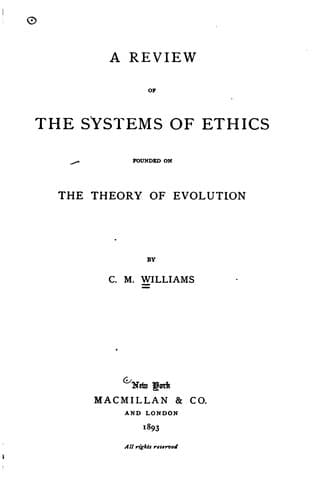
A Review of the Systems of Ethics Founded on the Theory of EvolutionWilliams, Cora May
Philosophy
A Review of the Systems of Ethics Founded on the Theory of Evolution
Williams, Cora May
Ethics, Evolutionary
As the organs of inferior animals are moulded into fitness for the
requirements of life, so, simultaneously, through nervous modifications,
their sensations, instincts, emotions, and intellectual aptitudes are
also moulded to these requirements,--in the gregarious animals to the
conditions of gregarious life. Many evolutionists appear to regard the
variability of man as ceasing with civilized life, but the whole analogy
of nature is against such a theory; we must assume that man, like other
animals, is moulded to suit his requirements, and that moral changes are
among those thus wrought out. Aggressive actions often entail suffering
on the individuals of a group performing them, as well as on the group
as a whole, and on the other hand, harmonious cooeperation in a group
profits the average of its members; so that there is a tendency to
survival of groups having such adaptation of nature. And just as a love
of property, formerly gratified by possession of food and shelter, came
later to be extended to the weapons for obtaining these, and, later,
even to the raw materials, the pleasure in ownership becoming more and
more abstract and remote from material satisfaction, so the natural
impatience of animal nature at restraint of its powers becomes in man a
sentiment of egoistic justice, for justice requires the free play of all
forces in order that the results of character may fall upon the
individual. It is more difficult to understand how the altruistic
sentiment of justice comes into being. On one hand, its implication is
that it can be developed only by adaptation to social life; on the
other, it appears that social life is impossible without the maintenance
of those equitable relations which imply a sentiment of justice. These
requirements are fulfilled by a pro-altruistic sentiment of justice,
which takes its place. The first deterrent from aggression, among
animals, is fear of retaliation; a further restraint, with man, is fear
of reprobation or social disgrace. To these are to be added the feelings
arising under political and religious authority--the dread of legal
punishment and the dread of divine vengeance; and these four kinds of
feelings cooeperate, forming a body of feeling, which checks the
primitive tendency to pursue the objects of desire without regard to the
interests of fellow-men, and though containing nothing of the altruistic
sentiment of justice, makes social cooeperation possible. Creatures which
become gregarious, tend to become sympathetic in degrees proportionate
to their intelligence--by sympathy being meant the arousing of kindred
feeling by the witness of a display of feeling in others, sympathy being
fostered by common enjoyments and sufferings. The altruistic sentiment
of justice is slow in assuming a high form, "partly because its primary
component does not become highly developed until a late phase of
progress, partly because it is relatively complex, and partly because it
Public-domain text, read in full here on John Shaqi.
Reviews
Reviews
No reviews yet
Be the first to share your thoughts on this work.
Elsewhere in the archive
Join the Discussion
Join the discussion
Sign in to leave a comment or review.
Sign InorCreate an account