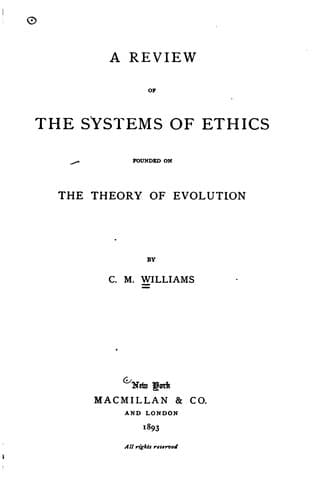
A Review of the Systems of Ethics Founded on the Theory of EvolutionWilliams, Cora May
Philosophy
A Review of the Systems of Ethics Founded on the Theory of Evolution
Williams, Cora May
Ethics, Evolutionary
All movements are rhythmical, social movements included, and after the
idea of justice in which inequality predominates comes a conception in
which the idea of equality unduly predominates--as in Bentham's ethical
theory, where "one person's happiness, supposed equal in degree (with
proper allowance made for kind), is accounted for exactly as much as
another's"; and this is the theory which Communism would reduce to
practice. It is an absolute denial of the principle of inequality, and
must apply alike to the worthy and unworthy, as well as to the superior
and inferior in physical and intellectual capacities, since moral
inequalities are as much inherited as others. Here we have a deliberate
abolition of that cardinal distinction between the ethics of the family
and the ethics of the state emphasized at the outset--"an abolition
which, as we saw, must eventuate in decay and disappearance of the
species or variety in which it takes place."
The true principle shows an amalgamation of these two. "The equality
concerns the mutually limited spheres of action which must be maintained
if associated men are to cooeperate harmoniously. The inequality concerns
the results which each may achieve by carrying on his actions within the
implied limits. No incongruity exists when the ideas of equality and
inequality are applied, the one to the bounds and the other to the
benefits. Contrariwise, the two may be, and must be, simultaneously
asserted."
"Any considerable acceptance of so definite an idea of justice is not to
be expected. It is an idea appropriate to an ultimate state, and can be
but partially entertained during transitional states; for the prevailing
ideas must, on the average, be congruous with existing institutions and
activities." During the thirty, or rather forty years' peace, and
weakening of militant organization, the idea of justice became clearer;
but since then the idea of regimentation has spread. It is predominant
in the conception of socialism with its army of workers with appointed
tasks and apportioned shares of products, and every act of Parliament
which takes money from the individual for public purposes shows a
tendency in the same direction. In the countries where militancy is most
pronounced, socialism is most highly developed. "Sympathy, which, a
generation ago, was taking the shape of justice, is relapsing into
generosity; and the generosity is exercised by inflicting injustice.
Daily legislation betrays little anxiety that each shall have that which
belongs to him, but great anxiety that he shall have that which belongs
to somebody else."
The formula of justice may be expressed thus: "Every man is free to do
that which he wills, provided he infringes not the equal freedom of any
other man."
Public-domain text, read in full here on John Shaqi.
Reviews
Reviews
No reviews yet
Be the first to share your thoughts on this work.
Elsewhere in the archive
Join the Discussion
Join the discussion
Sign in to leave a comment or review.
Sign InorCreate an account