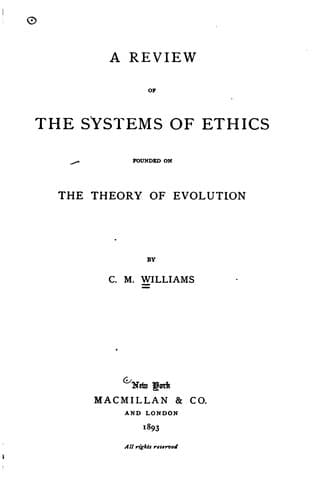
A Review of the Systems of Ethics Founded on the Theory of EvolutionWilliams, Cora May
Philosophy
A Review of the Systems of Ethics Founded on the Theory of Evolution
Williams, Cora May
Ethics, Evolutionary
implies a stretch of imagination not possible for low intelligences."
As, until pain has been felt, there cannot be sympathy with pain, so the
altruistic sentiment of justice cannot be developed until the egoistic
sentiment has arisen; moreover, the sentiment of justice is concerned,
not only with concrete pains and pleasures, but also with their
conditions, and hence this sentiment demands a development of the power
of mental representation.
There is a close connection between the sentiment of justice and the
social type. Predominant militancy affords no scope for the egoistic
sentiment of justice, and at the same time sympathy is perpetually
seared by militant activities. On the other hand, as fast as voluntary
cooeperation, which characterizes the industrial type of society, becomes
more general than compulsory cooeperation, which characterizes the
militant type of society, individual activities become less restrained,
and the sentiment which rejoices in the scope for them is encouraged;
while simultaneously, the occasions for repressing the sympathies become
less frequent.
The idea of justice is different from the mere sentiment of justice; the
former gradually arising from the latter, in the course of generations,
by experience of the limits to which action can be carried without
causing resentment from others. But since the kinds of activity are many
and become increasingly various with the development of social life, it
is a long time before the general nature of the limit common to all
cases can be conceived. A further reason for the slowness of development
is, that the arising ideas of justice have been perpetually confused by
the conflicting requirements of internal amity and external enmity.
Two elements, a positive and a negative, constitute the idea of
justice--that of man's recognition of his claims to unimpeded activities
and the results they bring, and that of the limits which the presence of
other men necessitate. The primordial ideal suggested is inequality, for
since the principal is that each should receive the results due to his
own nature, then, since men differ in their powers, unequal benefits are
implied. But mutual limitations suggest a contrary idea, experience
showing that the bounds to which one may pursue his own ends are, on the
average, the same for all, so that the idea of equality arises.
Unbalanced appreciations of these two factors in human justice lead to
divergent moral and social theories.
Among the rudest men the appreciations are no higher than among inferior
gregarious animals. Where war has developed political organization the
idea of inequality predominates, but the idea is one, not of natural,
but of artificial apportionment. And in general, we find that the
primary or brute factor in justice is but little qualified by the human
factor.
Public-domain text, read in full here on John Shaqi.
Reviews
Reviews
No reviews yet
Be the first to share your thoughts on this work.
Elsewhere in the archive
Join the Discussion
Join the discussion
Sign in to leave a comment or review.
Sign InorCreate an account