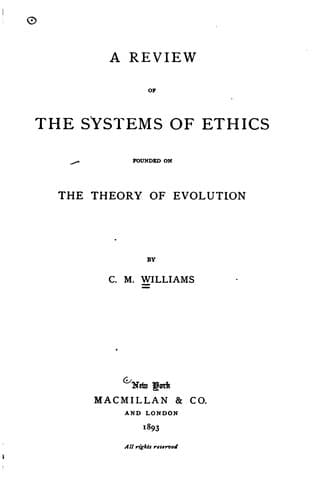
A Review of the Systems of Ethics Founded on the Theory of EvolutionWilliams, Cora May
Philosophy
A Review of the Systems of Ethics Founded on the Theory of Evolution
Williams, Cora May
Ethics, Evolutionary
Vol. I. of "The Principles of Ethics," including Parts I., II., and
III., appeared in August, 1892. In this volume, "The Data of Ethics,"
reprinted as Part I., remains unchanged, except for one or two
unimportant sentences. To this Part I. is, however, appended a chapter
which was, according to Mr. Spencer, written for the first publication
of "The Data of Ethics," but was either put aside for some reason, or
else overlooked, probably the latter, says the author, since it contains
material which should have been embodied. The chapter is headed "The
Conciliation," and seems to correspond to the two chapters on "Trial and
Compromise" and "Conciliation" which follow the chapters on "Egoism
_versus_ Altruism," and "Altruism _versus_ Egoism"; for it begins with a
consideration of the conflict of claims shown by "the last two
chapters," the apparent impossibility of the establishment of an
equilibrium, and the consequent apparent necessity of self-sacrifice.
But this conflict between egoism and altruism is merely transitional and
is in process of gradual disappearance, in the same manner in which the
present degree of conciliation of the two has been reached,--namely, by
the growth of such a constitution in each creature as entails pleasure
in altruistic action. Even with the lower animals, the acts which are
necessary to care for ova or young are the fulfilment of an instinct
which is gratified by the act; and in the human race, conciliation
between egoism and altruism, which goes hand in hand with evolution, has
reached a high degree. In the evolution of the human race itself, from
savagery to its present condition, there has been a marked increase of
this conciliation; this is true not only in the family, but to a small
extent also with regard to the larger groups of men constituting
societies. There is decrease of cruelty, increase of justice, both in
the form of state institutions and in their methods of administration,
more active benevolence, and a public sentiment that leads large numbers
of people to find egoistic gratification in the pursuit of the general
good even to the neglect of private interests. Self-sacrifice thus
ceases to be sacrifice in the ordinary sense of the word, since it comes
to bring with it more pleasure than pain. The future must hold in store
changes analogous to those of the past, but these must go on much more
rapidly under the present comparatively peaceful organization of society
than they have during the militant life of the past. This moral
development is retarded, however, not only by the degree of militancy
yet existing, but also by the necessity for a certain degree of
bluntness of feeling, too great sensitiveness to the suffering of others
entailing, while the pressure of population is as great as at present, a
misery that would make life intolerable. It is likely that, with social
progress, human fertility will decrease as cerebral activity increases,
Public-domain text, read in full here on John Shaqi.
Reviews
Reviews
No reviews yet
Be the first to share your thoughts on this work.
Elsewhere in the archive
Join the Discussion
Join the discussion
Sign in to leave a comment or review.
Sign InorCreate an account