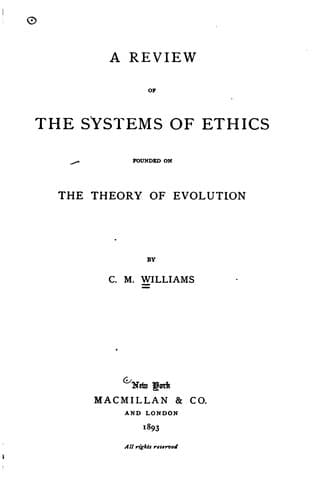
A Review of the Systems of Ethics Founded on the Theory of EvolutionWilliams, Cora May
Philosophy
A Review of the Systems of Ethics Founded on the Theory of Evolution
Williams, Cora May
Ethics, Evolutionary
until a comparative balance of fertility and mortality is reached as
"human evolution approaches its limit of complete adaptation to the
social state"; and sympathy will increase in proportion, no longer
entailing on its possessor more of pain than of pleasure, but the
contrary. "Sympathy is the root of every other kind of altruism than
that which, from the beginning, originates the parental activities. It
is the root of that higher altruism which, apart from the
philoprogenitive instinct, produces desire for the happiness of others
and reluctance to inflict pain upon them. These two traits are
inevitably associated. The same mental faculty which reproduces in the
individual consciousness the feelings that are being displayed by other
beings, acts equally to reproduce those states when they are pleasurable
or when they are painful."
The general corollary from the above-described process of evolution is
that, with the increase of sympathy there arises the double result, that
by its increase it tends to decrease the causes of human misery, and in
proportion as it does this, it becomes itself the cause of further
reflected happiness received by each from others. "And the limit towards
which this evolution approaches is one under which, as the amount of
pain suffered by those around from individual imperfections and from
imperfections of social arrangement and conduct, becomes relatively
small, and simultaneously the growth of sympathy goes on with little
check, the sympathy becomes at the same time almost exclusively a source
of pleasure received from the happiness of others, and not of pains
received from their pains. And as this condition is approached, the
function of sympathy is not that of stimulating to self-sacrifice and of
entailing upon its possessor positive or negative pain, but its function
becomes that of making him a recipient of positive pleasure." Thus
altruism will overgrow egoism, becoming itself a source of egoistic
pleasure, and eventually, with the diminution of the pressure of
population, there will come a state in which egoism and altruism are so
conciliated that the one merges in the other.
Among the social animals, with the ant and the bee, for instance, who
cannot be supposed to possess a sense of duty, we see that this
identification of egoism and altruism, as necessary to social life, has
taken place to a considerable extent; and since pleasure of every kind
is the concomitant of nervous structure, we can understand the pleasure
in altruistic as well as in egoistic activities, as soon as there exists
the nervous structure answering to these activities. As certainly as
there yet exist in civilized men instincts of the chase inherited from
savage ancestors, there are growing up and will continue to grow up in
men, these other structures which will prompt to altruistic activities.
Public-domain text, read in full here on John Shaqi.
Reviews
Reviews
No reviews yet
Be the first to share your thoughts on this work.
Elsewhere in the archive
Join the Discussion
Join the discussion
Sign in to leave a comment or review.
Sign InorCreate an account