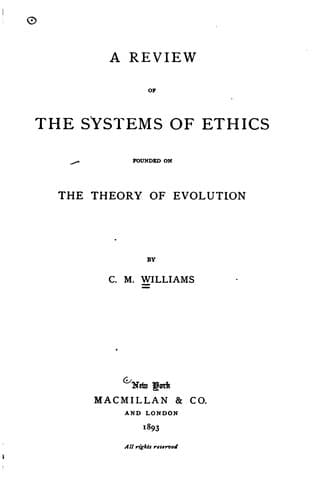
A Review of the Systems of Ethics Founded on the Theory of EvolutionWilliams, Cora May
Philosophy
A Review of the Systems of Ethics Founded on the Theory of Evolution
Williams, Cora May
Ethics, Evolutionary
The earlier condition of things was a state of universal warfare, on
account of the limitation of the food-supply. This warfare was checked
by the beginnings of industrial civilization, which made it possible for
a vastly greater population to live upon a given area, and in many ways
favored social compactness. A new basis of political combination was now
furnished by territorial continuity and by community of occupation. The
supply of food was no longer strictly limited, for it could be
indefinitely increased by peaceful industry; and, moreover, in the free
exchange of the products of labor, it ceased to be true that one man's
interest was opposed to another's. Men did not, it is true, at once
recognize this fact, but have done so only gradually. When the clan had
grown into the state, and the state into the empire, in which many
states were brought together in pacific relations, the recognized sphere
of moral obligation became enlarged, until at length it comprehended all
mankind. The coalescence of groups of men into larger and larger
political aggregates has been the chief work of civilization; and the
chief obstacle to such coalescence has been warfare. Great political
bodies have arisen in three ways. The first, conquest without
incorporation, proved itself suicidal. The second way was conquest with
incorporation, but without representation; and this lacking, the
government retrograded and gradually became a despotism. The third
method, federation, has been the policy of the English government. The
advantage of the habit of self-government has been shown in England's
wide conquest and colonization. The federative method of political
union, pacific in its very conception, is assuming an unquestionable
sway and destined to become universal; the progress of the race will be,
as it has been, with the gradual elimination of warfare.
In a race of inferior animals, any maladjustment is quickly removed by
natural selection. But in man there is a wide interval between the
highest and lowest degree of completeness which are compatible with
maintenance of life; in all grades of civilization above the lowest,
there are so many kinds of superiorities which severally enable men to
survive, notwithstanding accompanying inferiorities, that natural
selection cannot, by itself, rectify any particular unfitness. Hence,
the action of natural selection upon man has long since been essentially
diminished through the operation of social conditions. Therefore the
wicked flourish. Vice is but slowly eliminated, because mankind has so
many other qualities, besides the bad ones, which enable it, in spite of
them, to subsist and achieve progress.
Public-domain text, read in full here on John Shaqi.
Reviews
Reviews
No reviews yet
Be the first to share your thoughts on this work.
Elsewhere in the archive
Join the Discussion
Join the discussion
Sign in to leave a comment or review.
Sign InorCreate an account