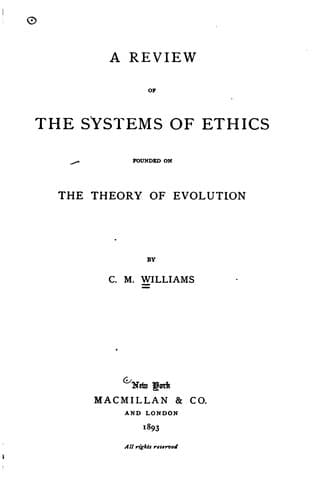
A Review of the Systems of Ethics Founded on the Theory of EvolutionWilliams, Cora May
Philosophy
A Review of the Systems of Ethics Founded on the Theory of Evolution
Williams, Cora May
Ethics, Evolutionary
The fundamental difference between civilized man and the savage lies in
the representative power, the imagination, by which men comprehend
pleasure and pain in others. Use and disuse, in place of natural
selection, have come to be paramount with man; and though the ethical
emotions are still too feeble, they will be more and more strengthened
by use, while the manifestation of selfish and hateful feelings will be
more and more weakened by disuse. Man is slowly passing from a primitive
social state, in which he was little better than a brute, toward an
ultimate social state, in which his character shall have become so
transformed that nothing of the brute can be detected in it. The
"original sin" of theology is the brute inheritance, which is being
gradually eliminated; and the message of Christianity: "Blessed are the
meek, for they shall inherit the earth" will be realized in the state of
universal peace towards which mankind is tending. Strife and Sorrow
shall disappear. Peace and Love shall reign supreme. The goal of
evolution is the perfecting of man, whereby we see, more than ever, that
he is the chief object of divine care, the fruition of that creative
energy which is manifested throughout the knowable universe.
We know soul only in connection with body. Yet nothing could be more
grossly unscientific than the famous remark of Cabanis that the brain
secretes thought as the liver secretes bile; the molecular movements of
the brain and the phenomena of thought and feeling are merely
concomitants related in some unknown way. It is not even correct to say
that thought goes on in the brain. He who regards man as the consummate
fruition of creative energy and the chief object of divine care, is
almost irresistibly driven to the belief that the soul's career is not
completed with the life upon the earth. Difficulties to this theory he
will meet; yet the alternative view contains difficulties at least as
great; nor is there any problem in the simplest and most exact
departments of science which does not speedily lead us to a
transcendental problem that we can neither solve nor elude. A broad
common sense argument has often to be called in, where keen-edged
metaphysical analysis has confessed itself baffled. The doctrine of
evolution does not allow us to take the atheistic view of the position
of man; the Darwinian theory, properly understood, replaces as much
teleology as it destroys. In the Titanic events of the development of
worlds from the nebular mist and their after-destruction, we may find no
signs of purpose, or even of a dramatic tendency; but on the earth we do
find distinct indications of a dramatic tendency; though doubtless not
of purpose in the limited human sense. Are we to regard the Creator's
work as like that of a child, who builds houses out of blocks just for
the pleasure of knocking them down again? On such a view the riddle of
the universe becomes a riddle without a meaning. "I can see no
Public-domain text, read in full here on John Shaqi.
Reviews
Reviews
No reviews yet
Be the first to share your thoughts on this work.
Elsewhere in the archive
Join the Discussion
Join the discussion
Sign in to leave a comment or review.
Sign InorCreate an account