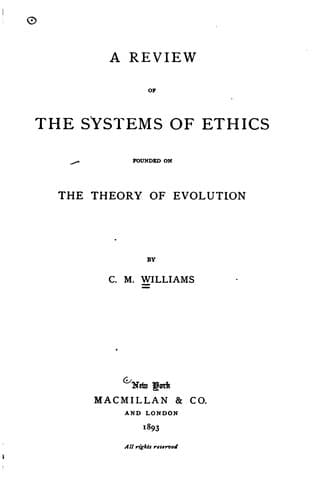
A Review of the Systems of Ethics Founded on the Theory of EvolutionWilliams, Cora May
Philosophy
A Review of the Systems of Ethics Founded on the Theory of Evolution
Williams, Cora May
Ethics, Evolutionary
less certainty the further from us any animal is in its organization. A
comparison such as Spencer institutes is possible only with respect to
like functions of similar organs in closely related forms.
The assertion that increase of ability for self-preservation leads to
better care for the young, and makes of such care a duty, is likewise
erroneous. For, up to the highly organized class of the crustacea, we
have no example of care for the young. In the struggle for existence,
the species which survive must be such as not only are in themselves
best fitted for survival, but as also bring forth best fitted progeny.
Nor has Spencer made clear on what ground natural process is to be
regarded as identical with duty. In truth he has succeeded in showing
only that care for the young is wide-spread in the animal kingdom, from
which fact naturally follows that it is a quality which tends to the
preservation of species.
It cannot be conceded that such a perfection as Spencer pictures, where
each shall fulfil all the functions of his own life in the most perfect
and complete manner without interfering with a like freedom in others,
is possible. The assertion involves the extension to all living beings
of that ideal principle of equal claims which Spencer repudiates with
regard to man,--showing that not all men are capable of a like degree of
happiness and that individuals desire, moreover, pleasure differing in
quality. Furthermore, a world of beings which, like the animals and many
plants, can support life only by means of organic material, must, in
order to exist, destroy organic life, either animal or vegetable. The
theory does not even hold with regard to individuals of the same
species; Spencer himself acknowledges the truth of the principles of
Malthus and of Darwin, according to which, even with the lowest rate of
increase, a struggle of competition must soon arise between individuals
of the same species.
Nor does Spencer's proof of the fundamental character of altruism hold,
on investigation. He demonstrates that through the animal species up to
man, there is less and less self-sacrifice of the mother animal in
giving birth to offspring. But this physical sacrifice is not altruism;
altruism lies in conscious care for the young after birth, and this is
not lessened, but increased, the higher we ascend.
Public-domain text, read in full here on John Shaqi.
Reviews
Reviews
No reviews yet
Be the first to share your thoughts on this work.
Elsewhere in the archive
Join the Discussion
Join the discussion
Sign in to leave a comment or review.
Sign InorCreate an account