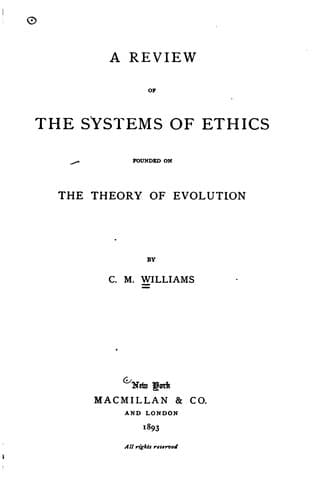
A Review of the Systems of Ethics Founded on the Theory of EvolutionWilliams, Cora May
Philosophy
A Review of the Systems of Ethics Founded on the Theory of Evolution
Williams, Cora May
Ethics, Evolutionary
Rolph here introduces a long criticism of the different schools. Against
utilitarianism he urges that, in so far as it makes the happiness of the
greatest number its principle, it asserts the right of the majority over
a minority, and so advocates, by implication, an absolute subjection to
authority.
Our whole moral education has for its aim to give the young as high a
conception as possible of the happiness which springs from virtue and,
on the other hand, to decry the pleasure which may result from forbidden
acts. We seek, in this manner, to diminish the inward struggle and bring
about the right result. He who has grown up under good influences
escapes many temptations to which a man of less moral education falls a
prey. According to Wallock, who makes the degree of inner struggle the
measure of virtue, the man of better education in this case, the more
moral man, must have less merit than the less moral man. Wallock thus
founders on the rock which Kant so skilfully avoids; according to the
former, the man whose lusts have been mastered by education could never
equal the man of evil instincts, and the chastity of a Magdalen must be
regarded as more moral than that of a pure woman.
Spencer's theory, that the conduct of the higher animals is better
adjusted to ends than that of lower species, is erroneous; the lower
animals are exactly as well organized for the ends of their existence as
are the higher animals for theirs; the tapeworm is relatively just as
perfect as the human being, in comparison with whom he possesses many
superior qualities. The common judgment that the human being is superior
does not accord with the real adjustment of things, but with our human
conception of the ideal end of organization, our anthropocentric idea of
the aim of life. We foolishly believe that the tapeworm and every other
animal has the same end as the human being, and rank the animals
according to this principle, instead of tracing the different
genealogical branches to a like height and then comparing them. Not the
fitness for ends, but the kind and multiplicity of the ends for which
there is fitness, determine our judgment; and the ends by which we judge
are those of our own life. We judge subjectively and absolutely instead
of objectively and relatively. We are ever unconsciously influenced by
the conception that nature, in creating the tapeworm, merely made a
false step and a step backwards in her way towards the creation of man.
That all animals are adapted, some in a greater, some in a less degree,
to the ends of their existence, is proved by the simple fact of their
existence, that is, of their survival in the struggle for existence; but
which are in a higher, and which are in a less degree so adapted, is, in
the individual instance, extremely difficult to determine. In any
attempt at such an estimate, we must meet with peculiar difficulties,
resulting from the fact that we judge of the adaptation to ends with
Public-domain text, read in full here on John Shaqi.
Reviews
Reviews
No reviews yet
Be the first to share your thoughts on this work.
Elsewhere in the archive
Join the Discussion
Join the discussion
Sign in to leave a comment or review.
Sign InorCreate an account