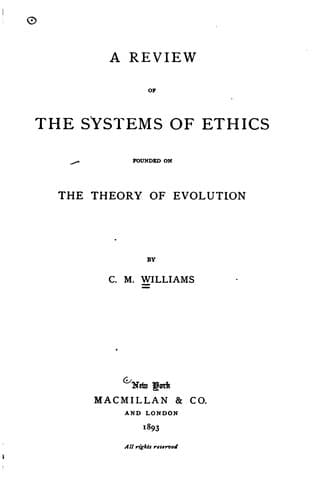
A Review of the Systems of Ethics Founded on the Theory of EvolutionWilliams, Cora May
Philosophy
A Review of the Systems of Ethics Founded on the Theory of Evolution
Williams, Cora May
Ethics, Evolutionary
Rolph thinks Spencer's theory awakes the conjecture that it was not
first arrived at through investigation, but rests upon a preconceived
opinion, as do to a greater or less extent all theories on this subject.
It seems as if the author had first attached himself to that theory
which best accorded with his scientific bias, and then tried whether
this theory might be proved or supported by facts of biology and
psychology. One might surmise, from the very skilful, but often too
artificial argument, that the author pursued the following train of
thought. Pleasure, and indeed the greatest possible pleasure, is the end
of endeavor in the organic world, that is, the psychical cause of
endeavor. May it not also be the physical cause?
Rolph answers this question with a denial, and endeavors to show that
the taking of food has its cause in the insatiability of all organic
substance. The theory of Spontaneous Generation contains nothing
impossible or improbable; is, on the contrary, a necessary logical
assumption not to be disproved by the mere result of experiment under
conditions of the laboratory. It is easy to imagine that organic
elements, which are to be found in great quantities in inorganic nature,
may come together by chance, or rather in the natural order of things,
to the formation of protoplasm.
The movement of these masses of protoplasm seems, at first glance, to
set the law of gravitation at defiance, but we may answer that an
ascending balloon might seem, to an uninstructed observer, to do the
same, although its movement is merely the natural result of that force;
it is not necessary, therefore, to assume a free inner motive, the soul,
as the cause of the one motion or the other. The first assimilation of
food has its beginning in the process of endosmose and exosmose, in
which the protoplasm, as in general the denser fluid, increases in
volume, taking up more than it gives out; the process occurring, in
detail, according to the special relations of attraction in the parts.
The organism always takes up the greatest amount possible under the
circumstances, exactly as, in the inorganic world, water takes up the
greatest amount possible of salt or any other soluble substance; the
growth of a crystal, and the oxidation of iron are illustrations of the
same principle. Of the limit of this capacity to take up new matter into
the organism we know nothing; all recent experiments go to show that the
organism is capable, under propitious circumstances, of an enormous
receptivity, such as, under natural conditions, it never reaches. The
lower animals feed continually, and their whole lives are passed in this
employment. In plants the tendency is seen still more clearly.
Experiments with electric, violet, and ultra-violet light show an
enormous growth in plants exposed to its action. But this can be only an
indirect growth, namely, the exorbitant acceleration of organic change
and assimilation. This fact is proved by experiments turning on increase
Public-domain text, read in full here on John Shaqi.
Reviews
Reviews
No reviews yet
Be the first to share your thoughts on this work.
Elsewhere in the archive
Join the Discussion
Join the discussion
Sign in to leave a comment or review.
Sign InorCreate an account