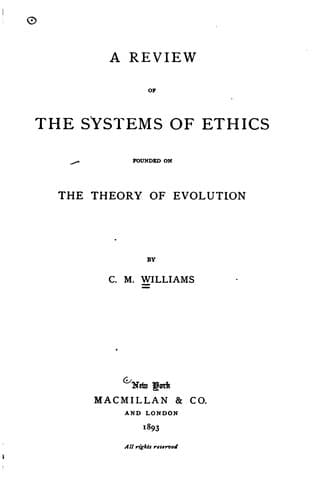
A Review of the Systems of Ethics Founded on the Theory of EvolutionWilliams, Cora May
Philosophy
A Review of the Systems of Ethics Founded on the Theory of Evolution
Williams, Cora May
Ethics, Evolutionary
of warmth in soil; from which is seen to result an unusual development
of that part of the plant to which growth is especially directed at the
time. When the warmth of an incubator is increased, the animal organ
especially engaged in development at the time is affected in like
manner. So that we may assume that the organism is capable of responding
to every demand that nature makes upon it under normal conditions; and
since the greatest possible assimilation under the existing conditions
is thus removed from the control of the creature, the latter appears
practically insatiable. This insatiability must appear to the observer
an inner impulse of the organism, an effort towards increase of
nourishment. It may be called mechanical hunger in distinction from
psychical hunger, of which it is the basis. It is not necessary to take
into consideration, in the question as to the degree of assimilation
possible, the amount of excretion of substance by the organism; we must,
on the contrary, assert that this is dependent upon the amount of
assimilation. The measure of growth depends, therefore, on the degree of
assimilation of new material. This degree, however, like the degree to
which the matter may be dissolved in a liquid in the case of inorganic
matter, is especially affected by light and warmth. The creature which
comes into existence in the sun will experience a decrease of organic
change when placed in the shade; and the creature which comes into
existence in the shade will experience an increase of such change under
the influence of the sun, a decrease again with a return to the shade.
This decrease means hunger,--harm. Experiments with zooespores throw an
interesting light upon these relations. They show that the zooespores,
although suited to very different degrees of light, all shun darkness.
Although when in the light they soon come to rest, divide, and copulate,
they remain, in the darkness, in a state of continual unrest and motion.
They grow so thin "that they almost excite pity" (Strassburger), and
finally perish of hunger. Only such zooespores as are distinguished by
sex and copulate come to rest, or those of such sorts as prey upon
others. It is easy to perceive that the unrest of the zooespores in the
darkness springs from lack of nourishment, from hunger; they seek
feverishly for the light, without which assimilation follows with
insufficient energy to satisfy need and render life possible. In
darkness, copulation alone can do this; copulation takes, then, the
place of normal nourishment.
Public-domain text, read in full here on John Shaqi.
Reviews
Reviews
No reviews yet
Be the first to share your thoughts on this work.
Elsewhere in the archive
Join the Discussion
Join the discussion
Sign in to leave a comment or review.
Sign InorCreate an account