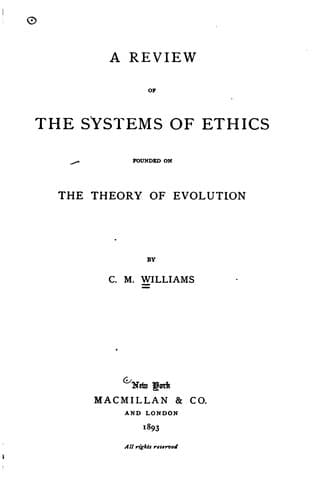
A Review of the Systems of Ethics Founded on the Theory of EvolutionWilliams, Cora May
Philosophy
A Review of the Systems of Ethics Founded on the Theory of Evolution
Williams, Cora May
Ethics, Evolutionary
With a like effort in the attempt to obtain food, that organism will be
best nourished which commands the best means of obtaining and preparing
its food,--the best apparatus for the seizure and grinding of food, and
the best salivary gland. And finally, greater surface of skin, of lungs,
of gills, or of intestines, causes greater capacity for assimilation,
and since this surface is increased by cell-division or propagation, the
capacity of the organism for assimilation grows with its capacity of
propagation.[59] Protoplasm is never entirely homogeneous, and we must
suppose some difference even in the beginning; such difference is,
indeed, fundamental through the very composition of protoplasm from the
four fundamental elements, and this or that other element. These
different elements must be held together by forces of attraction, and
the direction of these forces must have some common centre represented
by some differentiation of the protoplasm, whether as clearer spot, or
as nucleus. This spontaneously generated organism, neither animal nor
plant, is nourished, as we have seen, by diffusion, by the
transformation of inorganic into organic substance. The lowest organisms
possess no definite organs for taking food; they manifest, however,
phenomena of movement which are exactly like those of the animal
organism, for they appear unconditioned and hence voluntary. Locomotion
is, in the lowest animal forms, the only means of obtaining nourishment.
The amoeba surrounds and takes in whatever is by chance met with.
Animals a little higher in the scale swim about and seek their food; or,
remaining in one place, they cause, by means of cilia, a movement of the
water towards a certain part of the body, a sort of mouth where the
protoplasm is open and can take up the prey in the same manner as does
the amoeba. Ascending the scale of life, we find more and more
complicated apparatus for the seizure of food, for its preparation and
digestion, and the beginning of a nervous system, first as the
differentiation of certain muscle-cells, then in connection with a
special sense, that of hearing. If we assume any pleasure to be
connected with the earliest acts of assimilation, it must be that of the
satisfaction of a want, the stilling of pain in the form of hunger.
THE PROBLEM OF PERFECTIBILITY
Public-domain text, read in full here on John Shaqi.
Reviews
Reviews
No reviews yet
Be the first to share your thoughts on this work.
Elsewhere in the archive
Join the Discussion
Join the discussion
Sign in to leave a comment or review.
Sign InorCreate an account