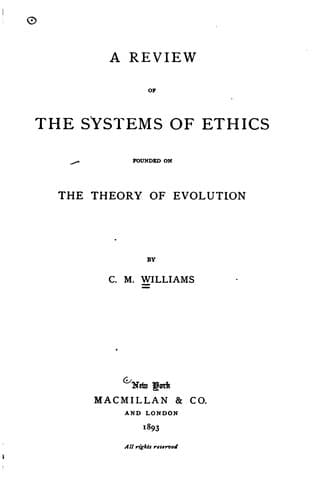
A Review of the Systems of Ethics Founded on the Theory of EvolutionWilliams, Cora May
Philosophy
A Review of the Systems of Ethics Founded on the Theory of Evolution
Williams, Cora May
Ethics, Evolutionary
In the earliest forms of propagation, the younger organism is a true
copy of that from which it springs, the trifling differences being due,
as Schmankewicz has shown, to outer influences. The differences of male,
female, worker, and soldier are due to such outer influences. The
differences in the younger organism, where propagation takes place
through copulation, may be explained by the mixture of types, through
which, by action and reaction, some qualities are intensified, while
some others become latent or are entirely destroyed. To these mutual
influences are to be added such as come from without, especially those
of warmth, and of quantity and quality of food. Under too great an
increase in temperature, the young organism may even be destroyed, the
process of assimilation not being able to keep pace with it. Those
variations which have led to the development of existing forms, that is,
which were favorable to life, are chiefly such as could be brought about
by relative or absolute increase of assimilation. This is true of
mental, as well as of physical, qualities.
It is a fact established without doubt, that the most common and most
widely distributed species show the greatest variability, and that those
species, on the contrary, which are now rare, although they were,
perhaps, at earlier periods, the most common and extremely variable,
vary, at the present date, the least of all. Following Darwin, one
generally draws the conclusion that the severity of the struggle for
existence favors the formation of varieties. For, it is said, the most
common species fight the severest battle with one another, while the
scanty representatives of rarer species come the least into competition
and continue unchanged. But this theory is, in two ways, erroneous. In
the first place, no attention is paid to the fact that a rare species
may be exposed to a severe struggle against another species for the same
nourishment, while a common species may, on the other hand, be exposed
to no such struggle, and, supporting life from a generous supply of
food, be subjected to but slight pressure. The conception of the
Darwinians means nothing more or less than that the individuals of a
species vary the more, the less favorable the conditions of nourishment;
and this cannot be conceded. Again, the fact is to be taken into
consideration, that the species at present common must have passed
through a favorable period in which food was so plentiful that it not
only afforded an abundance to individuals past the dangers of infancy
and youth, but allowed, in addition, the existence of an ever-increasing
number of individuals. And it is this period of increase, of abundance,
not a period of struggle, which has developed the variations we now have
before our eyes. In the same manner one must conclude, with regard to
the rarer species, that the formerly existing numerous varieties were
destroyed during the period of decline, that is, of overpowering
pressure.
Public-domain text, read in full here on John Shaqi.
Reviews
Reviews
No reviews yet
Be the first to share your thoughts on this work.
Elsewhere in the archive
Join the Discussion
Join the discussion
Sign in to leave a comment or review.
Sign InorCreate an account