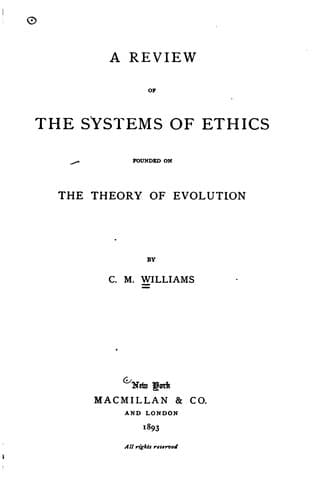
A Review of the Systems of Ethics Founded on the Theory of EvolutionWilliams, Cora May
Philosophy
A Review of the Systems of Ethics Founded on the Theory of Evolution
Williams, Cora May
Ethics, Evolutionary
The existence of morality presupposes the existence of commandments of
duty, and of an authority. Among animals, as well as among human beings,
we find recognized authority and can discern the principles of action
which constitute the duty of any particular animal. Authority among the
lower animals is based on might, which is, indeed, the universal source
of authority, without which no authority can exist. Personal authority
is but a particular form of the authority of circumstances; and to this
authority every creature must be subject. It consists of two factors:
the outer authority of the environment, and the inner authority of
impulse. Duty is obedience to authority. The duty of the organism
consists in action that corresponds to these two authorities, following
the direction given as the resultant of the mixture of the two
components. That is, that manner of life is right or moral which renders
the life of the organism the fullest possible under the circumstances.
The unreasoning organism is unconsciously drawn to seek this maximum,
while the reasoning being seeks it through reflection. The impulse to
happiness includes, therefore, for the reasoning being, the impulse to
morality; or, ideally expressed, the relative morality equals the
relative happiness; morality and happiness are the same thing.
An authority without the means of enforcing itself is a
self-contradiction. The means by which nature makes its authority felt
is organic excitation. In proportion to its strength, an excitation
produces sensation, in case it is not too weak to make itself felt at
all. Every excitation has a definite significance and may come from
without or within. Pleasant excitations are always, primarily, the
feeling of the stilling of pain, though there are pains, such as, for
instance, that of a wound, the toothache, headache, an aching corn,
which have no corresponding feeling of pleasure. Nor is pleasure the
only offspring of pain, since pain may bring forth pain. Pleasure
depends, in its character as pleasure as well as in its strength, on the
feeling preceding it in the organism; that is, its quality is the
result, not of the degree of organic excitation, but of the order of
succession of the feelings. For this reason, the same feeling which
brings pleasure to one individual may bring pain to another.
Public-domain text, read in full here on John Shaqi.
Reviews
Reviews
No reviews yet
Be the first to share your thoughts on this work.
Elsewhere in the archive
Join the Discussion
Join the discussion
Sign in to leave a comment or review.
Sign InorCreate an account