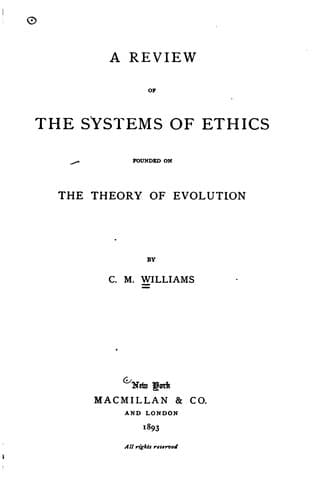
A Review of the Systems of Ethics Founded on the Theory of EvolutionWilliams, Cora May
Philosophy
A Review of the Systems of Ethics Founded on the Theory of Evolution
Williams, Cora May
Ethics, Evolutionary
This theory of development is, then, the opposite of that ordinarily
assumed. The latter asserts that increase of growth demands increase of
nourishment, whereas this asserts the fact that increase of nourishment
determines growth. The struggle for existence is not a struggle for the
mere necessaries to maintain life, but a struggle for increase of
acquisition, increase of life; it is not a struggle of defence, but an
attack which only under certain circumstances becomes a defence. The
rule with which we advise our friends is, "Forward! strive to better
yourself!" though we may endeavor, in hypocritical spirit, to persuade
to contentment those who come into competition with our interests.
The chief points, therefore, in which this theory differs from that of
Darwin, are as follows:--
"The struggle for existence is really a struggle for increase of
nourishment, of life; and independent of the supply of the moment, it
goes on at all times, hence even in a state of abundance.
"Limitation of supply by competition leads to fixation of the species
and, in the end, to its decrease and disappearance.
"Sickness, climate, and direct enemies are the destructive agencies, and
must secure more propitious conditions for survivors, the stronger their
effect.
"Only under conditions of prosperity can the survivors propagate
largely, and perfect themselves, separating into varieties and species.
"The increase and differentiation of the organic world shows us that
conditions of prosperity have been the rule, those of want the
exception."
Rolph's extremely interesting chapter on Propagation traces the sexual
instinct to the "mechanical hunger." The earliest example which may be
adduced in support of this theory is that of the zooespores which, by
copulation, sustain life for a time under the unfavorable conditions of
darkness, the thinner male representing, as does also the spermatozooen,
the seeking individual suffering from want, the female representing a
means of sustenance. The sex of the young organism is in like manner
referred by Rolph to conditions of nourishment during development. We
now come to the chapter on
ANIMAL OR NATURAL ETHICS
Public-domain text, read in full here on John Shaqi.
Reviews
Reviews
No reviews yet
Be the first to share your thoughts on this work.
Elsewhere in the archive
Join the Discussion
Join the discussion
Sign in to leave a comment or review.
Sign InorCreate an account