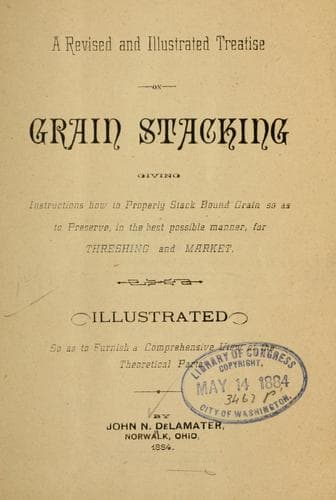
A revised and illustrated treatise on grain stackingDe Lamater, John N.
Science
A revised and illustrated treatise on grain stacking
De Lamater, John N.
Grain
If the stack is flat and as near an ellipse as the eye can judge, laying
out and keeping the stack properly balanced will be very easy. Drive
alternate loads on opposite sides of the stack; this will help to keep
the stack properly balanced. If the eye detects a place that seems to be
lower than the general level, it will be found that it was caused by
laying out more there than at other points; to remedy this defect, draw
in the next outside course at the low point, six, eight or ten inches,
according to the depression. The greater the depression, the more it
should be drawn in, and the next inside course at the low point should
be shoved out nearly to the buts of the outside course, then continue to
build as though nothing had happened. If a high place should be
observed, the next outside course should be laid farther out, and inside
course at this point drawn well in.
Glance frequently over the stack and see if the outside presents the
appearance of an ellipse, and keep a sharp lookout for high and low
spots, for they will throw the stack out of balance. If the middle is
too full, the outside will slip out, and an undesirable job of propping
will begin. Put in two-thirds of what is intended for the stack before
commencing to draw in.
Drive so as to leave a little space between load and stack. Don't let a
stack stand over night at this stage if it can be avoided, but put on
the next two loads as quickly as possible, for the outside of the stack
will settle rapidly.
FILLING THE MIDDLE.
Lay a tier of bundles through the central part half the length of the
stack, alternating heads and buts, then lay a course around with the
heads lapping across the middle tier; now another tier through the
center, and two courses around it; then another tier at center and
courses around, until the center is three or four feet higher than the
outside, depending on size of the stack, and the last course laid laps
half way from head to band on the outside course of the stack. It will
be seen that while building the main part of the stack, the courses were
laid from outside to center, and while filling the middle or putting in
the stuffing, the courses are laid from center towards outside. Now
commence outside, lay a course, heads out, half way from band to but on
outside course; in small stacks omit last instruction; then turn buts
out, lap half and lay to center; then lay a course around outside,
neither laying out or drawing in.
Now comes a point that should not be overlooked: lay a course, buts out,
lapping half way from heads to band on outside course; then lap half and
lay to center.
Public-domain text, read in full here on John Shaqi.
Reviews
Reviews
No reviews yet
Be the first to share your thoughts on this work.
Join the Discussion
Join the discussion
Sign in to leave a comment or review.
Sign InorCreate an account