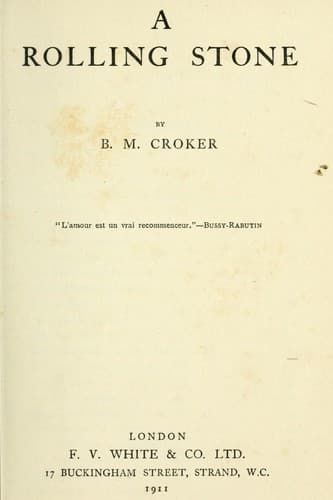
England -- Social life and customs -- 20th century -- Fiction; Household employees -- Fiction; Young men -- Fiction
In consequence of all this, the car’s driver had more time than ever
on his hands! The summer days are long, and, when off duty, he saw
a good deal of the Ramsays. The captain seemed of late to have sunk
into a further depth of mental lethargy, and to have lost much of his
affectionate interest in his old schoolfellow, Owen Wynyard.
“I am giving up the dogs for the present,” announced Mrs. Ramsay one
morning at the kennels, as he brought back three leg-weary companions.
“I find I must not continue what absorbs so much of my time and carries
me from home--though you are so good, and have undertaken the three
worst characters--they’re just as wild as goats.”
“But I like them,” he declared; “they are capital company, and give me
an object for my tramps--these two fox-terriers and the little beagle
and I are great chums. We have done a fine round this morning--they
have had the time of their lives! Just look at them!” and she looked
and smiled at their bespattered legs, lolling tongues, and happy eyes.
“Oh, I am sure of that,” she replied; “for they are three town dogs!
However, I must send the poor fellows away, all the same. I want to be
with Jim altogether, and without his knowing it. You see, he will never
allow me to walk with him; and he always fancies he is being watched,
and looks behind him every now and then. All the same, I mean to follow
him.”
Wynyard listened in silence. Mrs. Ramsay was, in his opinion, little
short of a saint; for years and years she had devoted her own
individual life to this unhappy madman. It was for him she slaved
to increase their small income, trading in plants and cuttings, and
keeping other people’s dogs. With the money she earned she made Ivy
House homelike and comfortable. The captain’s food, drink, tobacco,
and surroundings were of a class that the exterior of the place did
not seem to warrant, and were accepted by him as a matter of course.
Nothing could induce him to believe that their income was less than a
thousand a year; he had no recollection of his money losses. But this
long-drawn-out effort and strain was beginning to tell on his wife.
There were many white strands in her thick black hair, many lines in
her face; she had grown thin and haggard, her beautiful Irish eyes
were sunken, and wore an expression of tragic anxiety. She alone knew
what she dreaded, and at last she put her fears into words--not to
old friends like the Parson, or Susan Parrett, but to this recent
acquaintance, this young Wynyard, who knew so much already.
“Tell me, Owen, don’t you think that Jim looks rather strange of late?”
she asked him, in a low voice.
“No--much as usual.”
“He sleeps so badly, and has no appetite, and seems horribly depressed.
Oh, I feel miserable about him!” and she buried her face in her thin
hands.
“I wish I could do something, Mrs. Ramsay. Would you like me to stop
here at night--you know you’ve only to say the word,” he urged, in a
boyish tone that was irresistible.
Public-domain text, read in full here on John Shaqi.
Reviews
Reviews
No reviews yet
Be the first to share your thoughts on this work.
Elsewhere in the archive
Join the Discussion
Join the discussion
Sign in to leave a comment or review.
Sign InorCreate an account