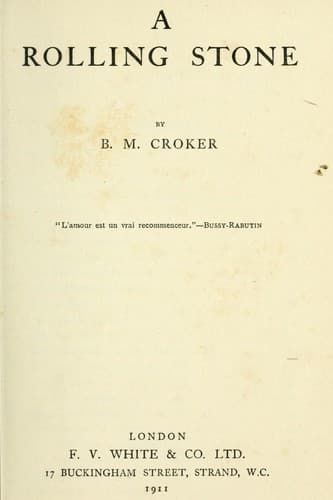
England -- Social life and customs -- 20th century -- Fiction; Household employees -- Fiction; Young men -- Fiction
“Anything is better than this half-and-half existence,” said Sir
Richard impatiently. “You have a long head, Martin, and I’ll take your
tip and put on all I can scrape. I’ll mortgage some outlying land, sell
some of the good pictures and the library, and be either a man or a
mouse. For once in my life I’ll do a big gamble. If I win, you say it’s
a big thing; if I lose, it means a few hundreds a year and a bedroom
near my club for the rest of my days. I take no middle course--I’ll be
a rich man or a pauper.”
And Sir Richard was as good as his word; he scraped up fifteen thousand
pounds, staked the whole sum on his venture--and won.
Subsequently, he cleared the property, invested in some securities,
began to feel at ease in the world, and travelled widely. Having
known the pinch and humiliation of genteel poverty and practised
stern self-denial in his youth, Sir Richard was naturally the
last man to have any sympathy with a nephew--a restless, reckless
scatter-brain--who was following in the footsteps of his squandering
forefathers. The good-looking young scapegrace must have a sharp
lesson, and learn the value of money and independence.
Lady Kesters’ promised interview with her uncle took place. He was fond
of Leila in his own brusque fashion, and secretly plumed himself on
having manœuvred her marriage.
“Well, Leila, I suppose you have come about this precious brother of
yours?” he began, as she was ushered into the smoking-room.
“Of course I have, Uncle Dick,” she replied, as she imprinted a kiss
upon his cheek and swept into a chair. “Something must be done!” and
she looked at him with speculative eagerness.
“There I agree with you,” he answered. “And Owen is the man to do it.
God helps those who help themselves!”
“Owen is most anxious to make another start; but it is not easy for a
soldier man, brought up as he has been.”
“Brought up as a rich man’s heir,” broke in her uncle, with a quick,
impatient movement; “more fool the rich man! I gave the fellow a good
education, good allowance, good send-off. I got him into his father’s
old regiment, and made him a decent allowance; he did fairly well in
India, I admit; but as soon as he came home to the depôt, he seemed
to have lost his head. Why, I believe the young scamp actually kept
racers, and as for his hunters, I never saw finer cattle in my life!
One day, when I happened to run down to Canterbury to visit him, I
noticed a servant exercising a couple of horses--such a pair! I was
bound to stop and admire them, and the groom informed me that they
belonged to Lieutenant Wynyard of the Red Hussars; and Mr. Wynyard’s
uncle hadn’t as much as a donkey to his name!”
“But could have thousands if he chose,” interposed Leila. “As for
racing, it was only his hunters Owen put into regimental steeplechases
and that sort of thing.”
Public-domain text, read in full here on John Shaqi.
Reviews
Reviews
No reviews yet
Be the first to share your thoughts on this work.
Join the Discussion
Join the discussion
Sign in to leave a comment or review.
Sign InorCreate an account