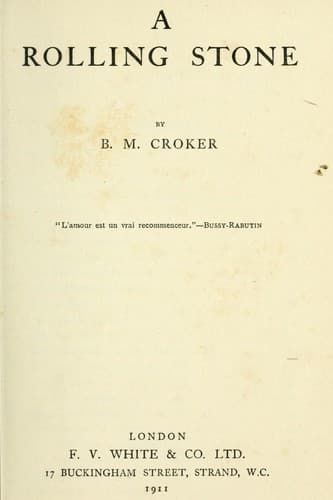
England -- Social life and customs -- 20th century -- Fiction; Household employees -- Fiction; Young men -- Fiction
It was evident that the lady was expecting some one, for there were two
cups and saucers on a well-equipped tea-table, placed between the sofa
and a cheerful log fire.
As the mistress of the house peers eagerly at passers-by, we may avail
ourselves of the opportunity to examine her surroundings. There is
an agreeable feeling of ample space, softly shaded lights, and rich
but subdued colours. The polished floor is strewn with ancient rugs;
bookcases and rare cabinets exhibit costly contents; flowers are in
profusion; the air is heavily scented with white lilac; and a multitude
of magazines and papers lie scattered about in careless abundance. _The
Hibbert Journal_, the _Clarion_, _Le Revue des deux mondes_, and the
_Spectator_ indicate a Catholic taste; but we look in vain for a piano,
a pet dog, or a workbasket.
As Lady Kesters turns from the window, it is seen that she is tall
and slim, with dark, expressive eyes, a delicate, tip-tilted nose,
and remarkably square chin; her figure, which is faultless, shows to
admirable advantage in a simple gown of clinging black material.
And whilst she once more subsides into her sofa and book, we may
venture to introduce a little sketch of her personal history.
Leila Wynyard and her brother Owen were the orphan children of a
dashing cavalry officer, who was killed at polo, leaving family
and creditors to the benevolence of his relations. Sir Richard,
his brother, undertook charge of the boy, the girl--some years his
senior--fell to the lot of a maiden aunt who lived in Eaton Terrace,
and maintained considerable dignity in a small house, on an income to
correspond. Leila had lessons and masters, her teeth, complexion, and
deportment were objects of anxious solicitude; at eighteen she was
brought out and presented, and hopes were entertained that, in her
first or second season, she would make a suitable match, and secure
a husband and a home. The girl carried herself with grace, had fine
dark eyes, and fine fashionable connections; these latter combined to
take her into society, and exhibit her at Ascot and Hurlingham, as
well as balls and the opera. She visited historical country seats and
notable Scottish moors, and was, so to speak, passed along from one
house-party to another; and yet, despite her friends’ exertions, Leila
Wynyard failed to “go off.” Perhaps the truth lay in the simple fact
that the lady herself was disinclined to move on; and often joked over
her social failure with her Aunt Eliza, who had a keen sense of humour
and no mind to lose the light of her old age.
On the other hand, Leila Wynyard was known to be penniless! (for what
is a hundred a year?--it scarcely keeps some women in hats) had no
surpassing accomplishments to lift her out of the ruck; it was also
whispered that she had an independent character, and a sharp tongue!
Public-domain text, read in full here on John Shaqi.
Reviews
Reviews
No reviews yet
Be the first to share your thoughts on this work.
Join the Discussion
Join the discussion
Sign in to leave a comment or review.
Sign InorCreate an account