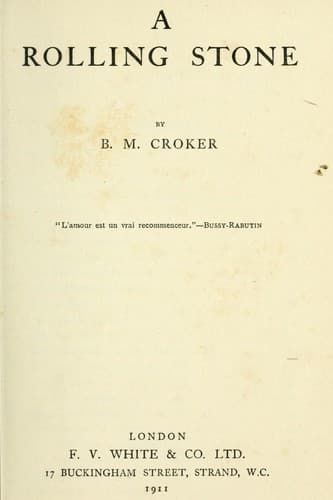
England -- Social life and customs -- 20th century -- Fiction; Household employees -- Fiction; Young men -- Fiction
“I gave him his passage and outfit, and put a few hundreds into the
concern as a spec. and to insure him an interest, and within twelve
months here he is back again on my hands--the proverbial rolling
stone!” He cleared his throat, and continued: “Now, Leila, my girl, you
have a head on your shoulders, and you know that these rolling stones
find their way to the bottom, and I am going to block my specimen in
good time. I suppose he told you what I said to him yesterday?”
“Yes; he came straight to Mount Street from seeing you.”
“He has got to shift for himself for two years, to earn his bread,
with or without butter, to guarantee that he does not take a penny
he has not worked for, that he does not get into debt or any
matrimonial engagement; should he marry a chorus-girl, by Jove I’ll
burn down Wynyard! If, by the end of that time, he turns up a steady,
industrious, independent member of society, I will make him my
agent--he shall have an adequate allowance, the house to live in, and
most of my money when I am dead!”
Lady Kesters was about to speak, but with a hasty gesture her uncle
interposed.
“I may as well add that I think myself safe in offering this prize, for
it’s my belief that Owen will never win it. He has the family fever in
his veins--the rage for gambling--and he is like the patriarch Reuben,
‘unstable as water and cannot excel.’ At the end of six months he will
be penniless, and you and Kesters will have to come to his rescue; for
my part _I_ wash my hands of him.”
“Uncle Dick,” she said, rising, “I think you are too hard on Owen;
he would not have come back from South America if he had not had a
row with the manager of the Estancia: surely you could not expect an
English gentleman--an Englishman--to stand by and see a poor woman
nearly beaten to death?”
“Oh,” with an impatient whirl of his glasses, “the fellow has always as
many excuses as an Irishman!”
“I think you are unjust,” she said, with a flash in her dark eyes.
“I admit that Owen has been extravagant and foolish, but he was not
worse, or half as bad, as many young men in his position. Are you quite
determined? Won’t you give Owen another chance--or even half a chance?”
“No; his future is now in his own hands, and I stick to what I’ve
said,” he declared, with irritable vehemence. “You came here, my
clever Leila, to talk me over. Oh, you are good at that, but it’s no
go this time! I am honestly giving the boy his only remedy. Let me
see,” sitting down at his bureau, “what is the date? Yes--look here--I
make an entry. I give Owen two years from to-day to work out his
time--to-day is the thirty-first of March.”
“But why not wait until to-morrow, and make it the first of April?”
suggested his niece, with a significant and seductive smile.
“Leila,” he spluttered, “I’m astonished at you! You jeer at me because
I’m not disposed to keep your beloved brother as an ‘_objêt de luxe_,’
eh?”
Public-domain text, read in full here on John Shaqi.
Reviews
Reviews
No reviews yet
Be the first to share your thoughts on this work.
Join the Discussion
Join the discussion
Sign in to leave a comment or review.
Sign InorCreate an account