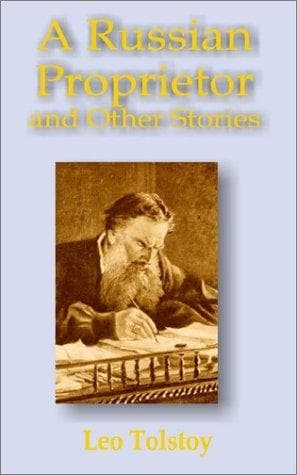
A Russian Proprietor, and Other StoriesTolstoy, Leo, graf
General
A Russian Proprietor, and Other Stories
Tolstoy, Leo, graf
Russia -- Social life and customs -- Fiction; Tolstoy, Leo, graf, 1828-1910 -- Translations into English
When Nekhliudof sat down on the bench again, and silence was restored in
the room, interrupted only by the sobs of the old woman, who was once more
busy under the loft, and was wiping away her tears with the sleeves of her
shirt, the young proprietor began to comprehend what was meant for the
peasant and his wife by the dilapidated little hut, the crumbling well with
the filthy pool, the decaying stalls and sheds, and the broken willows
which could be seen before the crooked window; and the feeling that arose
in him was burdensome, melancholy, and touched with shame.
"Why didn't you tell the Commune last Sunday, Iván, that you needed a new
hut? I don't know, now, how to help you. I told you all at the first
meeting, that I had come to live in the country, and devote my life to you,
that I was ready to deprive myself of every thing to make you happy and
contented; and I vowed before God, now, that I would keep my word," said
the young proprietor, not knowing that such a manner of opening the heart
is incapable of arousing faith in any one, and especially in the Russian,
who loves not words but deeds, and is reluctant to be stirred up by
feelings, no matter how beautiful they may be.
But the simple-hearted young man was so pleased with this feeling that he
experienced, that he could not help speaking.
Churis leaned his head to one side, and slowly blinking, listened with
constrained attention to his master, as to a man to whom he must needs
listen, even though he says things not entirely good, and absolutely
foreign to his way of thinking.
"But you see I cannot do all that everybody asks of me. If I did not refuse
some who ask me for wood, I myself should be left without any, and I could
not give to those who really needed. When I made this rule, I did it for
the regulation of the peasants' affairs; and I put it entirely in the hands
of the Commune. This wood now is not mine, but yours, you peasants', and I
cannot any longer dispose of it; but the Commune disposes of it, as you
know. Come to the meeting to-night. I will tell the Commune about your
request: if they are disposed to give you a new hut, well and good; but I
haven't any more wood. I wish with all my soul to help you; but if you
aren't willing to move, then it is no longer my affair, but the Commune's.
Do you understand me?"
"Many thanks for your kindness," replied Churis in some agitation. "If you
will give me some lumber, then we can make repairs. What is the Commune?
It's a well-known fact that"....
"No, you come."
"I obey. I will come. Why shouldn't I come? Only this thing is sure: I
won't ask the Commune."
IV.
The young proprietor evidently desired to ask some more questions of the
peasants. He did not move from the bench; and he glanced irresolutely, now
at Churis, now at the empty, unlighted stove.
"Well, have you had dinner yet?" he asked at last.
Public-domain text, read in full here on John Shaqi.
Reviews
Reviews
No reviews yet
Be the first to share your thoughts on this work.
Join the Discussion
Join the discussion
Sign in to leave a comment or review.
Sign InorCreate an account