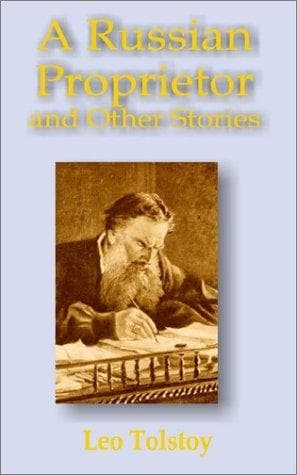
A Russian Proprietor, and Other StoriesTolstoy, Leo, graf
General
A Russian Proprietor, and Other Stories
Tolstoy, Leo, graf
Russia -- Social life and customs -- Fiction; Tolstoy, Leo, graf, 1828-1910 -- Translations into English
The situation was embarrassing for the young prince: he hastily got up from
the bench, went out into the entry, and called to Churis to follow him. The
sight of the man whom he had been befriending was so pleasant that he found
it hard to tear himself away.
"I am glad to help you," said he, halting by the well. "It's in my power to
help you, because I know that you are not lazy. You will work, and I will
assist you; and, with God's aid, you will come out all right."
"There's no hope of coming out all right, your excellency," said Churis,
suddenly assuming a serious and even stern expression of countenance, as
though the young man's assurance that he would come out all right had
awakened all his opposition. "In my father's time my brothers and I did not
see any lack; but when he died, we broke all up. It kept going from bad to
worse. Perfect wretchedness!"
"Why did you break up?"
"All on account of the women, your excellency. It was just after your
grandfather died; when he was alive, we should not have ventured to do it:
then the present order of things came in. He was just like you, he took an
interest in every thing; and we should not have dared to separate. The late
master did not like to look after the peasants; but after your
grandfather's time, Andréï Ilyitch took charge. God forgive him! he was a
drunken, careless man. We came to him once and again with complaints,--no
living on account of the women,--begged him to let us separate. Well, he
put it off, and put it off; but at last things came to such a pass, the
women kept each to their own part; we began to live apart; and, of course,
what could a single peasant do? Well, there wasn't no law or order. Andréï
Ilyitch managed simply to suit himself. 'Take all you can get.' And
whatever he could extort from a peasant, he took without asking. Then the
poll-tax was raised, and they began to exact more provisions, and we had
less and less land, and the grain stopped growing. Well, when the new
allotment was made, then he took away from us our manured land, and added
it to the master's, the villain, and ruined us entirely. He ought to have
been hung. Your father[15]--the kingdom of heaven be his!--was a good
bárin, but it was rarely enough that we ever had sight of him: he always
lived in Moscow. Well, of course they used to drive the carts in pretty
often. Sometimes it would be the season of bad roads,[16] and no fodder;
but no matter! The bárin couldn't get along without it. We did not dare to
complain at this, but there wasn't system. But now your grace lets any of
us peasants see your face, and so a change has come over us; and the
overseer is a different kind of man. Now we know for sure that we have a
bárin. And it is impossible to say how grateful your peasants are for your
kindness. But before you came, there wasn't any real bárin: every one was
bárin. Ilyitch was bárin, and his wife put on the airs of a lady,[17] and
the scribe from the police-station was bárin.
Public-domain text, read in full here on John Shaqi.
Reviews
Reviews
No reviews yet
Be the first to share your thoughts on this work.
Join the Discussion
Join the discussion
Sign in to leave a comment or review.
Sign InorCreate an account