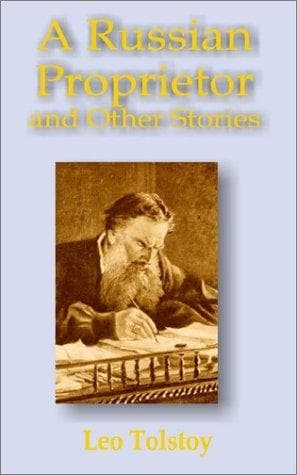
A Russian Proprietor, and Other StoriesTolstoy, Leo, graf
General
A Russian Proprietor, and Other Stories
Tolstoy, Leo, graf
Russia -- Social life and customs -- Fiction; Tolstoy, Leo, graf, 1828-1910 -- Translations into English
"What stupidity! All that I knew, all that I believed in, all that I
loved," he had said to himself. "Love is self-denying; this is the only
true happiness independent of chance," he had said over and over again,
smiling and waving his hands.
Applying this thought on every side to life, and finding in it confirmation
both of life and that inner voice which told him that this was _it_, he had
experienced a new feeling of pleasant agitation and enthusiasm.
"And so I ought to do good if I would be happy," he thought; and all his
future vividly came up before him, not as an abstraction, but in images in
the form of the life of a proprietor.
He saw before him a huge field, conterminous with his whole life, which he
was to consecrate to the good, and in which really he should find
happiness. There was no need for him to search for a sphere of activity; it
was all ready. He had one out-and-out obligation: he had his serfs....
And what comfortable and beneficent labor lay before him! "To work for this
simple, impressionable, incorruptible class of people; to lift them from
poverty; to give them pleasure; to give them education which, fortunately,
I will turn to use in correcting their faults, which arise from ignorance
and superstition; to develop their morals; to induce them to love the
right.... What a brilliant, happy future! And besides all this, I, who am
going to do this for my own happiness, shall take delight in their
appreciation, shall see how every day I shall go farther and farther toward
my predestined end. A wonderful future! Why could I not have seen this
before?
"And besides," so he had thought at the same time, "who will hinder me from
being happy in love for a woman, in enjoyment of family?"
And his youthful imagination portrayed before him a still more bewitching
future.
"I and my wife, whom I shall love as no one ever loved a wife before in the
world, we shall always live amid this restful, poetical, rural nature, with
our children, maybe, and with my old aunt. We have our love for each other,
our love for our children; and we shall both know that our aim is the
right. We shall help each other in pressing on to this goal. I shall make
general arrangements; I shall give general aid when it is right; I shall
carry on the farm, the savings bank, the workshop. And she, with her dear
little head, and dressed in a simple white dress, which she lifts above
her dainty ankle as she steps through the mud, will go to the peasants'
school, to the hospital, to some unfortunate peasant who in truth does not
deserve help, and everywhere carry comfort and aid.... Children, old men,
women, will wait for her, and look on her as on some angel, as on
Providence. Then she will return, and hide from me the fact that she has
been to see the unfortunate peasant, and given him money; but I shall know
all, and give her a hearty hug, and rain kisses thick and fast on her
lovely eyes, her modestly-blushing cheeks, and her smiling, rosy lips."
XIX.
Public-domain text, read in full here on John Shaqi.
Reviews
Reviews
No reviews yet
Be the first to share your thoughts on this work.
Join the Discussion
Join the discussion
Sign in to leave a comment or review.
Sign InorCreate an account