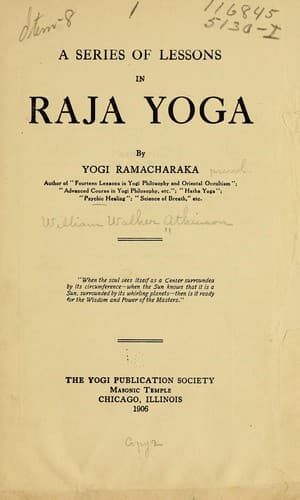
A Series of Lessons in Raja YogaAtkinson, William Walker
Religion
A Series of Lessons in Raja Yoga
Atkinson, William Walker
Yoga; Yoga, Raja
In order to reassure readers who might object to having the student left
in this condition of reversed tastes, we may add that the Yogi teachers
then teach him to get rid of the idea of the disliked thing, and teach
him to cultivate a liking for all wholesome things, their theory being
that the dislike of certain wholesome eatables has been caused by some
suggestion in childhood, or by some prenatal impression, as wholesome
eatables are made attractive to the taste by Nature. The idea of all this
training, however, is not the cultivation of taste, but practice in
mental training, and the bringing home to the student the truth of the
fact that his nature is plastic to his Ego, and that it may be moulded at
will, by concentration and intelligent practice. The reader of this
lesson may experiment upon himself along the lines of the elementary Yogi
practice as above mentioned, if he so desires. He will find it possible
to entirely change his dislike for certain food, etc., by the methods
mentioned above. He may likewise acquire a liking for heretofore
distasteful tasks and duties, which he finds it necessary to perform.
The principle underlying the whole Yogi theory of Character Building by
the sub-conscious Intellect, is that the Ego is Master of the mind, and
that the mind is plastic to the commands of the Ego. The Ego or "I" of
the individual is the one real, permanent, changeless principle of the
individual, and the mind, like the body, is constantly changing, moving,
growing, and dying. Just as the body may be developed and moulded by
intelligent exercises, so may the mind be developed and shaped by the Ego
if intelligent methods are followed.
The majority of people consider that Character is a fixed something,
belonging to a man, that cannot be altered or changed. And yet they show
by their everyday actions that at heart they do not believe this to be a
fact, for they endeavor to change and mould the characters of those
around them, by word of advice, counsel, praising or condemnation, etc.
It is not necessary to go into the matter of the consideration of
the causes of character in this lesson. We will content ourselves by
saying that these causes may be summed up, roughly, as follows: (1)
Result of experiences in past lives; (2) Heredity; (3) Environment;
(4) Suggestion from others; and (5) Auto-suggestion. But no matter how
one's character has been formed, it may be modified, moulded, changed,
and improved by the methods set forth in this lesson, which methods are
similar to what is called by Western writers, "Auto-suggestion."
Public-domain text, read in full here on John Shaqi.
Reviews
Reviews
No reviews yet
Be the first to share your thoughts on this work.
Elsewhere in the archive
Join the Discussion
Join the discussion
Sign in to leave a comment or review.
Sign InorCreate an account