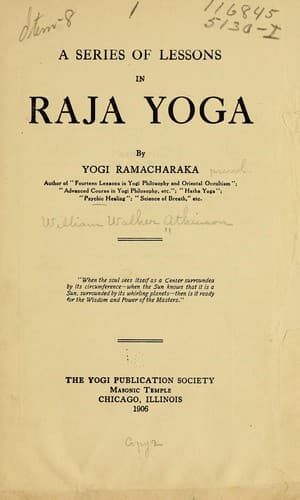
A Series of Lessons in Raja YogaAtkinson, William Walker
Religion
A Series of Lessons in Raja Yoga
Atkinson, William Walker
Yoga; Yoga, Raja
The average person recognizes his strong and weak points of character,
but is very apt to regard them as fixed and unalterable, or practically
so. He thinks that he "is just as the Lord made him," and that is the end
of it. He fails to recognize that his character is being unconsciously
modified every day by association with others, whose suggestions are
being absorbed and acted upon. And he fails to see that he is moulding
his own character by taking interest in certain things, and allowing his
mind to dwell upon them. He does not realize that he himself is really
the maker of himself, from the raw and crude material given him
at his birth. He makes himself negatively or positively. Negatively, if
he allows himself to be moulded by the thoughts and ideals of others,
and positively, if he moulds himself. Everyone is doing one or the
other--perhaps both. The weak man is the one who allows himself to be
made by others, and the strong man is the one who takes the building
process in his own hands.
The process of Character-building is so delightfully simple that its
importance is apt to be overlooked by the majority of persons who are
made acquainted with it. It is only by actual practice and the
experiencing of results that its wonderful possibilities are borne home
to one.
The Yogi student is early taught the lesson of the power and importance
of character building by some strong practical example. For instance, the
student is found to have certain tastes of appetite, such as a like for
certain things, and a corresponding dislike for others. The Yogi teacher
instructs the student in the direction of cultivating a desire and taste
for the disliked thing, and a dislike for the liked thing. He teaches the
student to fix his mind on the two things, but in the direction of
imagining that he likes the one thing and dislikes the other. The student
is taught to make a mental picture of the desired conditions, and to say,
for instance, "I loathe candy--I dislike even the sight of it," and, on
the other hand, "I crave tart things--I revel in the taste of them,"
etc., etc., at the same time trying to reproduce the taste of sweet
things accompanied with a loathing, and a taste of tart things,
accompanied with a feeling of delight. After a bit the student finds that
his tastes are actually changing in accordance with his thoughts, and in
the end they have completely changed places. The truth of the theory is
then borne home to the student, and he never forgets the lesson.
Public-domain text, read in full here on John Shaqi.
Reviews
Reviews
No reviews yet
Be the first to share your thoughts on this work.
Elsewhere in the archive
Join the Discussion
Join the discussion
Sign in to leave a comment or review.
Sign InorCreate an account