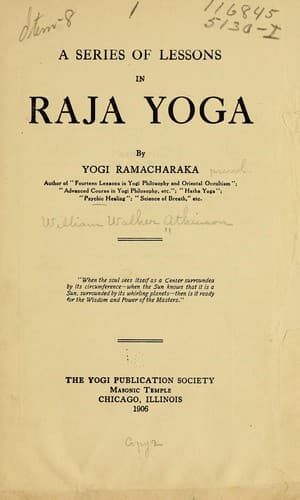
A Series of Lessons in Raja YogaAtkinson, William Walker
Religion
A Series of Lessons in Raja Yoga
Atkinson, William Walker
Yoga; Yoga, Raja
The sensations of the body, such as hunger; thirst; pain; pleasurable
sensations; physical desires, etc., etc., are not apt to be mistaken for
essential qualities of the "I" by many of the Candidates, for they have
passed beyond this stage, and have learned to set aside these sensations,
to a greater or lesser extent, by an effort of the Will, and are no
longer slaves to them. Not that they do not experience these sensations,
but they have grown to regard them as incidents of the physical
life--good in their place--but useful to the advanced man only when he
has mastered them to the extent that he no longer regards them as close
to the "I." And yet, to some people, these sensations are so closely
identified with their conception of the "I" that when they think of
themselves they think merely of a bundle of these sensations. They are
not able to set them aside and consider them as things apart, to be used
when necessary and proper, but as things not fastened to the "I." The
more advanced a man becomes the farther off seem these sensations. Not
that he does not feel hungry, for instance. Not at all, for he recognizes
hunger, and satisfies it within reason, knowing that his physical body is
making demands for attention, and that these demands should be heeded.
But--mark the difference--instead of feeling that the "_I_" is hungry the
man feels that "_my body_" is hungry, just as he might become conscious
that his horse or dog was crying for food insistently. Do you see what
we mean? It is that the man no longer identifies himself--the "I"--with
the body, consequently the thoughts which are most closely allied to the
physical life seem comparatively "separate" from his "I" conception. Such
a man thinks "my stomach, this," or "my leg, that," or "my body, thus,"
instead of "'I,' this," or "'I' that." He is able, almost automatically,
to think of the body and its sensations as things _of_ him, and
_belonging to_ him, which require attention and care, rather than as real
parts of the "I." He is able to form a conception of the "I" as existing
without any of these things--without the body and its sensations--and so
he has taken the first step in the realization of the "I."
Before going on, we ask the students to stop a few moments, and mentally
run over these sensations of the body. Form a mental image of them, and
realize that they are merely incidents to the present stage of growth and
experience of the "I," and that they form no real part of it. They may,
and will be, left behind in the Ego's higher planes of advancement. You
may have attained this mental conception perfectly, long since, but we
ask that to give yourself the mental drill at this time, in order to
fasten upon your mind this first step.
Public-domain text, read in full here on John Shaqi.
Reviews
Reviews
No reviews yet
Be the first to share your thoughts on this work.
Join the Discussion
Join the discussion
Sign in to leave a comment or review.
Sign InorCreate an account