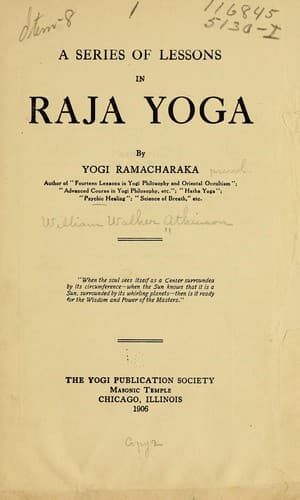
A Series of Lessons in Raja YogaAtkinson, William Walker
Religion
A Series of Lessons in Raja Yoga
Atkinson, William Walker
Yoga; Yoga, Raja
We have thought it well to make a slight change in the arrangement of
these lessons--that is, in the order in which they should appear. We had
contemplated making this Seventh Lesson a series of Mental Drills,
intended to develop certain of the mental faculties, but we have decided
to postpone the same until a later lesson, believing that by so doing a
more logical sequence or order of arrangement will be preserved. In this
lesson we will tell you of the unfoldment of consciousness in Man, and in
the next lesson, and probably in the one following it, we shall present
to you a clear statement regarding the states of mind, below and over
consciousness--a most wonderful region, we assure you, and one that has
been greatly misunderstood and misinterpreted. This will lead up to the
subject of the cultivation of the various faculties--both conscious and
outside of consciousness, and the series will be concluded by three
lessons going right to the heart of this part of the subject, and giving
certain rules and instruction calculated to develop Man's wonderful
"thought-machine" that will be of the greatest interest and importance
to all of our students. When the lessons are concluded you will see that
the present arrangement is most logical and proper.
In this lesson we take up the subject of "The Unfoldment of
Consciousness"--a most interesting subject. Many of us have been in the
habit of identifying "consciousness" with mind, but as we proceed with
this series of lessons we will see that that which is called
"consciousness" is but a small portion of the mind of the individual, and
even that small part is constantly changing its states, and unfolding new
states undreamed of.
"Consciousness" is a word we use very often in considering the science of
the Mind. Let us see what it means. Webster defines it as one's
"knowledge of sensations and mental operations, or of what passes in
one's own mind." Halleck defines it as "that undefinable characteristic
of mental states which causes one to be aware of them." But, as Halleck
states, "Consciousness is incapable of definition. To define anything we
are obliged to describe it in terms of something else. And there is
nothing else in the world like consciousness, hence we can define it only
in terms of itself, and that is very much like trying to lift one's self
by one's own boot straps. Consciousness is one of the greatest mysteries
that confronts us."
Before we can understand what Consciousness really is, we must know just
what "Mind" really is--and that knowledge is lacking, notwithstanding the
many injenious theories evolved in order to explain the mystery. The
metaphysicians do not throw much light on the subject, and as for
materialistic science, listen to what Huxley says: "How it comes about
that anything so remarkable as a state of consciousness comes about by
the result of irritating nervous tissue, is just as unaccountable as the
appearance of the genie when Aladdin rubbed his lamp."
Public-domain text, read in full here on John Shaqi.
Reviews
Reviews
No reviews yet
Be the first to share your thoughts on this work.
Elsewhere in the archive
Join the Discussion
Join the discussion
Sign in to leave a comment or review.
Sign InorCreate an account