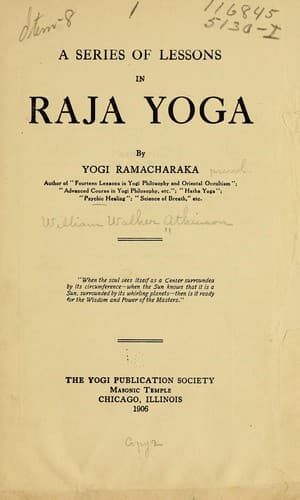
A Series of Lessons in Raja YogaAtkinson, William Walker
Religion
A Series of Lessons in Raja Yoga
Atkinson, William Walker
Yoga; Yoga, Raja
To many persons the words "consciousness" and "mental process," or
"thought" are regarded as synonymous. And, in fact, psychologists so held
until quite recently. But now it is generally accepted as a fact that
mental processes are not limited to the field of consciousness, and it is
now generally taught that the field of sub-consciousness (that is,
"under" conscious) mentation, is of a much greater extent than that of
conscious mentation.
Not only is it true that the mind can hold in consciousness but one fact
at any one instant, and that, consequently, only a very small fraction of
our knowledge can be in consciousness at any one moment, but it is also
true that the consciousness plays but a very small part in the totality
of mental processes, or mentation. The mind is not conscious of the
greater portion of its own activities--Maudsley says that only ten per
cent comes into the field of consciousness. Taine has stated it in these
words: "Of the world which makes up our being, we only perceive the
highest points--the lighted up peaks of a continent whose lower levels
remain in the shade."
But it is not our intention to speak of this great subconscious region of
the mind at this point, for we shall have much to do with it later on. It
is mentioned here in order to show that the enlargement or development of
consciousness is not so much a matter of "growth" as it is an
"unfoldment"--not a new creation or enlargement from outside, but rather
an unfoldment outward from within.
From the very beginning of Life--among the Particles of Inorganic
Substance, may be found traces of something like Sensation, and response
thereto. Writers have not cared to give to this phenomenon the name of
"sensation," or "sensibility," as the terms savored too much of "senses,"
and "sense-organs." But Modern Science has not hesitated to bestow the
names so long withheld. The most advanced scientific writers do not
hesitate to state that in reaction, chemical response, etc., may be seen
indications of rudimentary sensation. Haeckel says: "I cannot imagine
the simplest chemical and physical process without attributing the
movement of the material particles to unconscious sensation. The idea of
Chemical Affinity consists in the fact that the various chemical elements
perceive the qualitative differences in other elements and experience
'pleasure' or 'revulsion' at contacts with them, and execute their
specific movements on this ground." He also speaks of the sensitiveness
of "plasm," or the substance of "living bodies," as being "only a
superior degree of the general irritability of substance."
Public-domain text, read in full here on John Shaqi.
Reviews
Reviews
No reviews yet
Be the first to share your thoughts on this work.
Elsewhere in the archive
Join the Discussion
Join the discussion
Sign in to leave a comment or review.
Sign InorCreate an account