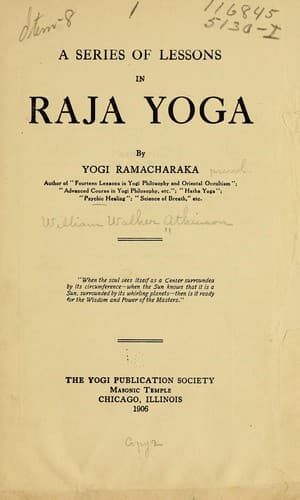
A Series of Lessons in Raja YogaAtkinson, William Walker
Religion
A Series of Lessons in Raja Yoga
Atkinson, William Walker
Yoga; Yoga, Raja
Among the higher forms of animal life, after a "dawn period" or
semi-consciousness, we come to forms of life among the lower animals
possessing a well developed degree of mental action and Consciousness,
the latter being called by psychologists "Simple Consciousness," but
which term we consider too indefinite, and which we will term "Physical
Consciousness," which will give a fair idea of the thing itself. We use
the word "Physical" in the double sense of "External," and "Relating to
the material structure of a living being," both of which definitions are
found in the dictionaries. And that is just what Physical Consciousness
really is--an "awareness" in the mind, or a "consciousness" of the
"external" world as evidenced by the senses; and of the "body" of the
animal or person. The animal or person thinking on the plane of Physical
Consciousness (all the higher animals do, and many men seem unable to
rise much higher) identifies itself with the physical body, and is
conscious only of thoughts of that body and the outside world. It
"knows," but not being conscious of mental operations, or of the
existence of its mind, it does not "know that it knows." This form of
consciousness, while infinitely above the mentation of the nonconscious
plane of "sansation," is like a different world of thought from the
consciousness of the highly developed intellectual man of our age and
race.
It is difficult for a man to form an idea of the Physical Consciousness
of the lower animals and savages, particularly as he finds it difficult
to understand his own consciousness except by the act of being conscious.
But observation and reason have given us a fair degree of understanding
of what this Physical Consciousness of the animal is like--or at least in
what respect it differs from our own consciousness. Let us take a
favorite illustration. A horse standing out in the cold sleet and rain
undoubtedly _feels_ the discomfort, and possibly pain, for we know by
observation that animals feel both. But he is not able to analyze his
mental states and wonder when his master will come out to him--think how
cruel it is to keep him out of the warm stable--wonder whether he will be
taken out in the cold again tomorrow--feel envious of other horses who
are indoors--wonder why he is compelled to be out cold nights, etc.,
etc.,--in short, he does not think as would a reasoning man under such
circumstances. He is aware of the discomfort, just as would be the
man--and he would run home if he could just as would the man. But he is
not able to pity himself, nor to think about his personality as would
the man, nor does he wonder whether such a life is worth living, after
all. He "knows," but is not able to think of himself as knowing--he does
not "know that he knows," as we do. He experiences the physical pain and
discomfort, but is spared the mental discomfort and concern arising from
the physical, which man so often experiences.
Public-domain text, read in full here on John Shaqi.
Reviews
Reviews
No reviews yet
Be the first to share your thoughts on this work.
Elsewhere in the archive
Join the Discussion
Join the discussion
Sign in to leave a comment or review.
Sign InorCreate an account