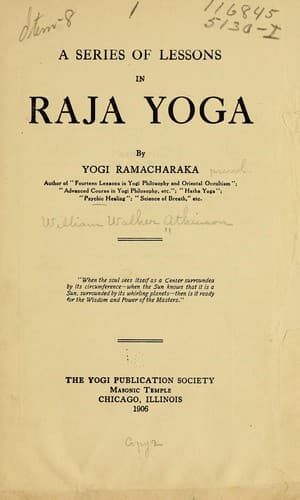
A Series of Lessons in Raja YogaAtkinson, William Walker
Religion
A Series of Lessons in Raja Yoga
Atkinson, William Walker
Yoga; Yoga, Raja
The animal cannot shift its consciousness from the sensations of the
outer world to the inner states of being. It is not able to "know
itself." The difference may be clumsily illustrated by the example of a
man feeling, seeing or hearing something that gives him a pleasurable
sensation, or the reverse. He is conscious of the feeling or sensation,
and that it is pleasurable or otherwise. That is Physical Consciousness,
and the animal may share it with him. But it stops right there with the
animal. But the man may begin to wonder _why_ the sensation is
pleasurable and to associate it with other things and persons; or
speculate _why_ he dislikes it, what will follow, and so on--that is
Mental Consciousness, because he recognizes an inward self, and is
turning his attention _inward_. He may see another man and experience a
feeling or sensation of attraction or aversion--like or dislike. This is
Physical Consciousness, and an animal also may experience the sensation.
But the man goes further than the animal, and wonders just what there is
about the man he likes or detests, and may compare himself to the man and
wonder whether the latter feels as he does, and so on--this is Mental
Consciousness.
In animals the mental gaze is freely directed outward, and never returns
upon itself. In man the mental gaze may be directed inward, or may return
inward after its outward journey. The animal "knows"--the man not only
"knows," but he "knows that he knows," and is able to investigate that
"knowing" and speculate about it. We call this higher consciousness
Mental Consciousness. The operation of Physical Consciousness we call
Instinct--the operation of Mental Consciousness we call Reason.
The Man who has Mental Consciousness not only "feels" or "senses" things,
but he has words or mental concepts of these feelings and sensations and
may think of himself as experiencing them, separating himself, the
sensation or feeling, and the thing felt or sensed. The man is able to
think: "I feel; I hear; I see; I smell; I taste; I desire; I do," etc.,
etc. The very words indicate Mental Consciousness recognizing mental
states and giving them names, and also recognizing something called "I"
that experiences the sensations. This latter fact has caused
psychologists to speak of this stage as "Self-consciousness," but we
reserve this idea of the "I" consciousness for a higher stage.
The animal experiences something that gives it the impressions or feeling
that we call "pain," "hurt," "pleasant," "sweet," "bitter," etc., all
being forms of sensation, but it is unable to think of them in words.
The pain seems to be a part of itself, although possibly associated with
some person or thing that caused it. The study of the unfoldment of
consciousness in a young baby will give one a far better idea of the
grades and distinctions than can be obtained from reading mere words.
Public-domain text, read in full here on John Shaqi.
Reviews
Reviews
No reviews yet
Be the first to share your thoughts on this work.
Elsewhere in the archive
Join the Discussion
Join the discussion
Sign in to leave a comment or review.
Sign InorCreate an account