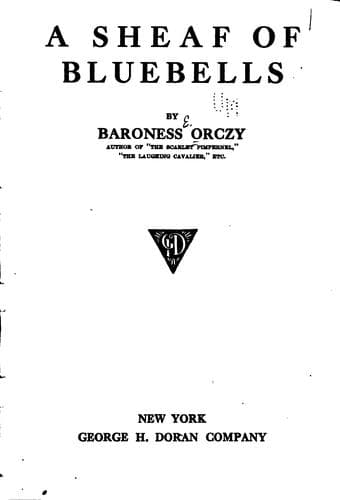
A Sheaf of BluebellsOrczy, Emmuska Orczy, Baroness
History
A Sheaf of Bluebells
Orczy, Emmuska Orczy, Baroness
France -- History -- Consulate and First Empire, 1799-1815 -- Fiction
In the evening when, in the small boudoir which had been made habitable,
the lamps were lit and a fire burned in the tall hearth, when the
shutters were closed and chairs drawn nearer to one another, the place
looked a trifle less desolate. Matthieu Renard and his wife Annette had
thrown up their work under the farmers and cultivators whom they
despised, and returned to serve the masters, whom even in their poverty
they recognized as alone worthy of their services. Annette had cooked a
good dinner, Matthieu had unearthed a bottle of wine from a disused
cellar, which had almost miraculously escaped perquisition. The world
did not appear so callous or so inimical as it had done earlier in the
day.
"What about Ronnay?" M. de Courson had asked as soon as Matthieu and
Annette had gone and the doors were closed on the intimate family
circle.
"What about him?" retorted Mme. la Marquise. The sound of her eldest
son's name grated unpleasantly on her ear.
"Does he know you have arrived?"
"Yes. I have written to him."
"So soon?"
"There was no object in wasting time. He and I will have to meet within
the next few days. I want to get that first meeting over."
"You have asked him to come here?"
"Of course."
"Do you think that he will come?"
"He cannot refuse to pay his respects to his mother."
M. de Courson shrugged his shoulders and stared moodily into the fire.
"Have you heard anything fresh about Ronnay de Maurel, Baudouin?"
queried Mme. la Marquise sharply. "Anything that I ought to know?"
"Only what is common talk round the neighbourhood, my dear," he
replied.
"And that is?..."
"That Gaston de Maurel has brought up his nephew--your son, my dear
Denise--as little better than the workmen in his factories. Ronnay, it
seems, is quite illiterate, and his manners are those of a peasant. The
most violent democratic principles have been inculcated into him from
childhood...."
"Ever since the law freed me from his father's brutalities ..." broke in
Madame coldly.
"Exactly," assented M. de Courson, in an obviously conciliatory spirit,
"when your husband died, my dear, his brother Gaston took up his work
with the boy. You know the type of man Gaston de Maurel always was--the
Revolution suited his temperament exactly. Cruel, vindictive, jealous,
violent, he voted for the September massacres and for the execution of
the King. Had Ronnay been old enough he, too, would have been a
regicide."
Mme. la Marquise shuddered.
"And even you, Baudouin," she said, "have oft rebuked me for my hatred
to the boy."
"Your son, Denise, your own flesh and blood. Aye!" he added more
emphatically, "so much your own flesh and blood; that he has your
character in a great measure--your energy, your enthusiasm....
Unfortunately he misapplies both...."
"To crime and disloyalty."
"Yes; there is the pity of it. He is a dangerous man, Denise," continued
M. de Courson earnestly. "It were best to keep him at arm's-length."
Public-domain text, read in full here on John Shaqi.
Reviews
Reviews
No reviews yet
Be the first to share your thoughts on this work.
Join the Discussion
Join the discussion
Sign in to leave a comment or review.
Sign InorCreate an account