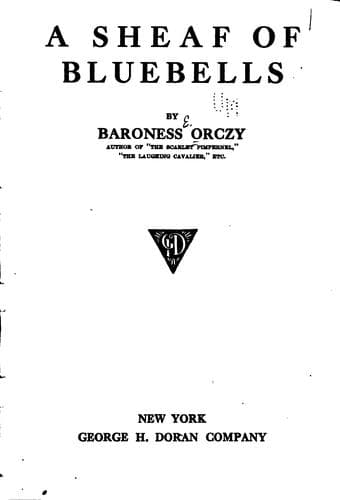
A Sheaf of BluebellsOrczy, Emmuska Orczy, Baroness
History
A Sheaf of Bluebells
Orczy, Emmuska Orczy, Baroness
France -- History -- Consulate and First Empire, 1799-1815 -- Fiction
"Well," resumed M. de Courson in his slow and deliberate way, "as to
that we are somewhat in the dark. Ronnay de Maurel, after spending
several months at La Vieuville, managing and reorganizing his factories,
went away again about a year ago, to rejoin the army--so 'twas
said--though I personally would have thought that his wounded leg
unfitted him for the hard campaigning to which Bonaparte subjects his
troops. Be that as it may, however, Ronnay de Maurel has been away from
home for over a year now. He only returned a few days ago--much aged and
still more severely crippled, so I am told. I have not seen him. While
he was away old Gaston de Maurel took up the reins of government at the
foundries in his own feeble hands. He seems to have rallied somewhat
unexpectedly after Ronnay's departure, and though he really is sinking
fast now--so they say--he certainly kept an eye on his nephew's
interests, with the help of a military commission whom the War Office
sent down here at Ronnay's desire to supervise the armament works."
"A military commission!" exclaimed d'Ache, with a contemptuous shrug of
his wide shoulders. "The War Office! Hark at the insolence of that
Corsican upstart!"
The others laughed, too. The Empire of France and its vast military and
civil organization were mere objects of derision to these irrefragable
Royalists.
"What was this military commission?" queried de Puisaye after a while.
"Ah, my good de Puisaye," exclaimed M. de Courson with a sigh, "you have
lived so completely out of the world these past six or seven years, that
I suppose you have no notion how absolutely this unfortunate country
has come under the sway of military dictatorship. Everything, my good
friend, is under military control--the police, of course; the
municipality, the hospitals, the schools, the Church--let alone
factories and munition foundries. Every man who owns and controls any
kind of armament works and who finds it difficult to cope with his men
has, it seems, the right to apply to the War Office to send him as many
representatives as he may deem expedient to help him keep his workers in
order. These representatives are really overseers with military rank and
military authority; very convenient for the masters, but none too
pleasant for the men!"
"Military tyranny invariably treads on the heels of democratic revolt,"
said Prigent sententiously. "The English have had their Cromwell, the
unfortunate French nation is groaning under its Bonaparte."
"It does very little groaning just now," quoth M. de Courson dryly.
"Bonaparte is amazingly popular. The army worships him--_cela va sans
dire_--but so does the populace. We have had great difficulty in
rallying the proletariat round here to their allegiance."
"Well," interjected d'Ache somewhat impatiently, "what did this military
commission do _enfin_? What did it consist of?"
Public-domain text, read in full here on John Shaqi.
Reviews
Reviews
No reviews yet
Be the first to share your thoughts on this work.
Elsewhere in the archive
Join the Discussion
Join the discussion
Sign in to leave a comment or review.
Sign InorCreate an account