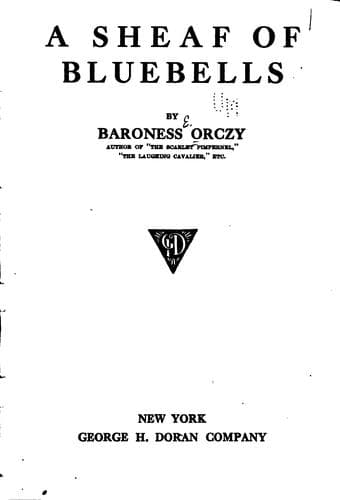
A Sheaf of BluebellsOrczy, Emmuska Orczy, Baroness
History
A Sheaf of Bluebells
Orczy, Emmuska Orczy, Baroness
France -- History -- Consulate and First Empire, 1799-1815 -- Fiction
"It consisted of four or five exceedingly vulgar men in uniform, who
ruled the Maurel foundries with a rod of iron. Punishments for slackness
and disobedience were doled out with a free hand, and the slightest
attempt at concerted grumbling was instantly met with handcuffs, arrest,
bread and water and other unpleasant manifestations of military
discipline. The men openly sighed for the return of 'the General,' as
they call Ronnay de Maurel, though he was none too pleasant a taskmaster
either, so I've been told."
"And I suppose that while that military commission sat at La Frontenay,
you were able to do very little in the way of recruiting for the King?"
"Very little indeed. You see, most of the able-bodied men in the
neighbourhood are employed in the foundries, and it is only here and
there that we have found a malcontent who was willing to come over to
us. But we have got the two hundred men from the powder factory; they
are ready to join us the moment your men march on La Frontenay."
"Ah!" exclaimed de Puisaye, as he once more rubbed his wrinkled hands
together with an excited gesture which seemed habitual to him. "Ah!
there you have it at last, my good d'Ache. Our friend de Courson has
explained the situation to you as it has been this past year; now let me
tell you how we stand at this present, and what causes me to be so
certain for the future. The two hundred men of whom de Courson speaks
are convicts employed solely in the more dangerous processes of the
manufacture of gunpowder. They are a rough, surly, discontented lot, who
live segregated from their fellow-workmen in compounds, which are under
special supervision, and they are subject to special discipline.
Personally, I should say that even so with these restrictions it was
pleasanter to manufacture gunpowder in the factories of La Frontenay
than in the jails of Caen or the galleys of Brest. But apparently Paul
Leroux, who is in some sort of way the acknowledged leader of the gang,
and his mates do not think so. They hate old Gaston de Maurel, they hate
Ronnay, they execrated the military commission. They only work under
strict compulsion--some say under the lash; in any case, they only work
under the terror of punishment, and they are ready at any moment to
rebel, to murder, to blow up the factory or to come in on our side--to
do anything, in fact, for a change from their present condition, and,
above all, for a bribe in the form of a promise of liberty and of
money."
Public-domain text, read in full here on John Shaqi.
Reviews
Reviews
No reviews yet
Be the first to share your thoughts on this work.
Elsewhere in the archive
Join the Discussion
Join the discussion
Sign in to leave a comment or review.
Sign InorCreate an account