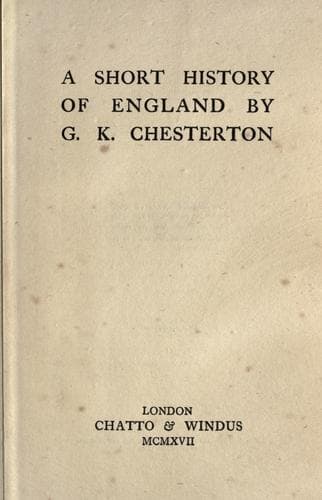
A Short History of EnglandChesterton, G. K. (Gilbert Keith)
History
A Short History of England
Chesterton, G. K. (Gilbert Keith)
Great Britain -- History
The transformation through which the external relations of England
passed at the end of the seventeenth century is symbolized by two very
separate and definite steps; the first the accession of a Dutch king and
the second the accession of a German king. In the first were present all
the features that can partially make an unnatural thing natural. In the
second we have the condition in which even those effecting it can hardly
call it natural, but only call it necessary. William of Orange was like
a gun dragged into the breach of a wall; a foreign gun indeed, and one
fired in a quarrel more foreign than English, but still a quarrel in
which the English, and especially the English aristocrats, could play a
great part. George of Hanover was simply something stuffed into a hole
in the wall by English aristocrats, who practically admitted that they
were simply stopping it with rubbish. In many ways William, cynical as
he was, carried on the legend of the greater and grimmer Puritanism. He
was in private conviction a Calvinist; and nobody knew or cared what
George was except that he was not a Catholic. He was at home the partly
republican magistrate of what had once been a purely republican
experiment, and among the cleaner if colder ideals of the seventeenth
century. George was when he was at home pretty much what the King of
the Cannibal Islands was when he was at home--a savage personal ruler
scarcely logical enough to be called a despot. William was a man of
acute if narrow intelligence; George was a man of no intelligence. Above
all, touching the immediate effect produced, William was married to a
Stuart, and ascended the throne hand-in-hand with a Stuart; he was a
familiar figure, and already a part of our royal family. With George
there entered England something that had scarcely been seen there
before; something hardly mentioned in mediaeval or Renascence writing,
except as one mentions a Hottentot--the barbarian from beyond the Rhine.
The reign of Queen Anne, which covers the period between these two
foreign kings, is therefore the true time of transition. It is the
bridge between the time when the aristocrats were at least weak enough
to call in a strong man to help them, and the time when they were strong
enough deliberately to call in a weak man who would allow them to help
themselves. To symbolize is always to simplify, and to simplify too
much; but the whole may be well symbolized as the struggle of two great
figures, both gentlemen and men of genius, both courageous and clear
about their own aims, and in everything else a violent contrast at every
point. One of them was Henry St. John, Lord Bolingbroke; the other was
John Churchill, the famous and infamous Duke of Marlborough. The story
of Churchill is primarily the story of the Revolution and how it
succeeded; the story of Bolingbroke is the story of the
Counter-Revolution and how it failed.
Public-domain text, read in full here on John Shaqi.
Reviews
Reviews
No reviews yet
Be the first to share your thoughts on this work.
Elsewhere in the archive
Join the Discussion
Join the discussion
Sign in to leave a comment or review.
Sign InorCreate an account