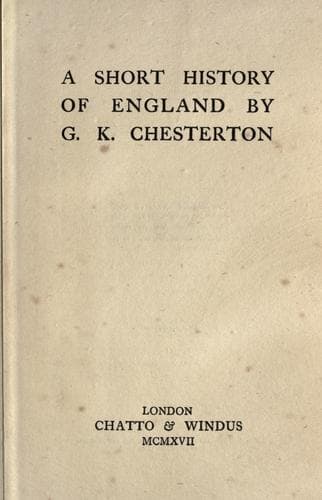
A Short History of EnglandChesterton, G. K. (Gilbert Keith)
History
A Short History of England
Chesterton, G. K. (Gilbert Keith)
Great Britain -- History
Churchill is a type of the extraordinary time in this, that he combines
the presence of glory with the absence of honour. When the new
aristocracy had become normal to the nation, in the next few
generations, it produced personal types not only of aristocracy but of
chivalry. The Revolution reduced us to a country wholly governed by
gentlemen; the popular universities and schools of the Middle Ages, like
their guilds and abbeys, had been seized and turned into what they
are--factories of gentlemen, when they are not merely factories of
snobs. It is hard now to realize that what we call the Public Schools
were once undoubtedly public. By the Revolution they were already
becoming as private as they are now. But at least in the eighteenth
century there were great gentlemen in the generous, perhaps too
generous, sense now given to the title. Types not merely honest, but
rash and romantic in their honesty, remain in the record with the names
of Nelson or of Fox. We have already seen that the later reformers
defaced from fanaticism the churches which the first reformers had
defaced simply from avarice. Rather in the same way the
eighteenth-century Whigs often praised, in a spirit of pure magnanimity,
what the seventeenth-century Whigs had done in a spirit of pure
meanness. How mean was that meanness can only be estimated by realizing
that a great military hero had not even the ordinary military virtues
of loyalty to his flag or obedience to his superior officers, that he
picked his way through campaigns that have made him immortal with the
watchful spirit of a thieving camp-follower. When William landed at
Torbay on the invitation of the other Whig nobles, Churchill, as if to
add something ideal to his imitation of Iscariot, went to James with
wanton professions of love and loyalty, went forth in arms as if to
defend the country from invasion, and then calmly handed the army over
to the invader. To the finish of this work of art but few could aspire,
but in their degree all the politicians of the Revolution were upon this
ethical pattern. While they surrounded the throne of James, there was
scarcely one of them who was not in correspondence with William. When
they afterwards surrounded the throne of William, there was not one of
them who was not still in correspondence with James. It was such men who
defeated Irish Jacobitism by the treason of Limerick; it was such men
who defeated Scotch Jacobitism by the treason of Glencoe.
Public-domain text, read in full here on John Shaqi.
Reviews
Reviews
No reviews yet
Be the first to share your thoughts on this work.
Elsewhere in the archive
Join the Discussion
Join the discussion
Sign in to leave a comment or review.
Sign InorCreate an account