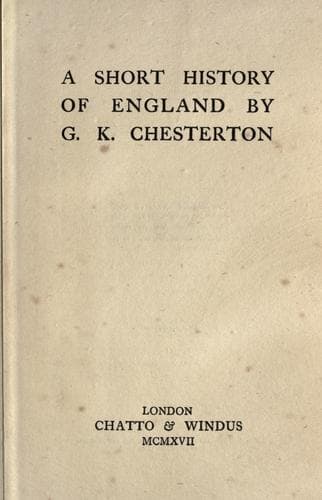
A Short History of EnglandChesterton, G. K. (Gilbert Keith)
History
A Short History of England
Chesterton, G. K. (Gilbert Keith)
Great Britain -- History
Thus the strange yet splendid story of eighteenth-century England is one
of greatness founded on smallness, a pyramid standing on a point. Or, to
vary the metaphor, the new mercantile oligarchy might be symbolized even
in the externals of its great sister, the mercantile oligarchy of
Venice. The solidity was all in the superstructure; the fluctuation had
been all in the foundations. The great temple of Chatham and Warren
Hastings was reared in its origins on things as unstable as water and as
fugitive as foam. It is only a fancy, of course, to connect the unstable
element with something restless and even shifty in the lords of the sea.
But there was certainly in the genesis, if not in the later generations
of our mercantile aristocracy, a thing only too mercantile; something
which had also been urged against a yet older example of that polity,
something called _Punica fides_. The great Royalist Strafford, going
disillusioned to death, had said, "Put not your trust in princes." The
great Royalist Bolingbroke may well be said to have retorted, "And least
of all in merchant princes."
Bolingbroke stands for a whole body of conviction which bulked very big
in English history, but which with the recent winding of the course of
history has gone out of sight. Yet without grasping it we cannot
understand our past, nor, I will add, our future. Curiously enough, the
best English books of the eighteenth century are crammed with it, yet
modern culture cannot see it when it is there. Dr. Johnson is full of
it; it is what he meant when he denounced minority rule in Ireland, as
well as when he said that the devil was the first Whig. Goldsmith is
full of it; it is the whole point of that fine poem "The Deserted
Village," and is set out theoretically with great lucidity and spirit in
"The Vicar of Wakefield." Swift is full of it; and found in it an
intellectual brotherhood-in-arms with Bolingbroke himself. In the time
of Queen Anne it was probably the opinion of the majority of people in
England. But it was not only in Ireland that the minority had begun to
rule.
Public-domain text, read in full here on John Shaqi.
Reviews
Reviews
No reviews yet
Be the first to share your thoughts on this work.
Elsewhere in the archive
Join the Discussion
Join the discussion
Sign in to leave a comment or review.
Sign InorCreate an account