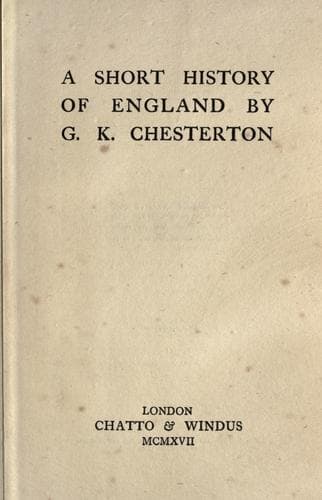
A Short History of EnglandChesterton, G. K. (Gilbert Keith)
History
A Short History of England
Chesterton, G. K. (Gilbert Keith)
Great Britain -- History
But the secret was worse; not only was such a family founded on
stealing, but the family was stealing still. It is a grim truth that all
through the eighteenth century, all through the great Whig speeches
about liberty, all through the great Tory speeches about patriotism,
through the period of Wandewash and Plassy, through the period of
Trafalgar and Waterloo, one process was steadily going on in the central
senate of the nation. Parliament was passing bill after bill for the
enclosure, by the great landlords, of such of the common lands as had
survived out of the great communal system of the Middle Ages. It is much
more than a pun, it is the prime political irony of our history, that
the Commons were destroying the commons. The very word "common," as we
have before noted, lost its great moral meaning, and became a mere
topographical term for some remaining scrap of scrub or heath that was
not worth stealing. In the eighteenth century these last and lingering
commons were connected only with stories about highwaymen, which still
linger in our literature. The romance of them was a romance of robbers;
but not of the real robbers.
This was the mysterious sin of the English squires, that they remained
human, and yet ruined humanity all around them. Their own ideal, nay
their own reality of life, was really more generous and genial than the
stiff savagery of Puritan captains and Prussian nobles; but the land
withered under their smile as under an alien frown. Being still at least
English, they were still in their way good-natured; but their position
was false, and a false position forces the good-natured into brutality.
The French Revolution was the challenge that really revealed to the
Whigs that they must make up their minds to be really democrats or admit
that they were really aristocrats. They decided, as in the case of their
philosophic exponent Burke, to be really aristocrats; and the result
was the White Terror, the period of Anti-Jacobin repression which
revealed the real side of their sympathies more than any stricken fields
in foreign lands. Cobbett, the last and greatest of the yeomen, of the
small farming class which the great estates were devouring daily, was
thrown into prison merely for protesting against the flogging of English
soldiers by German mercenaries. In that savage dispersal of a peaceful
meeting which was called the Massacre of Peterloo, English soldiers were
indeed employed, though much more in the spirit of German ones. And it
is one of the bitter satires that cling to the very continuity of our
history, that such suppression of the old yeoman spirit was the work of
soldiers who still bore the title of the Yeomanry.
Public-domain text, read in full here on John Shaqi.
Reviews
Reviews
No reviews yet
Be the first to share your thoughts on this work.
Elsewhere in the archive
Join the Discussion
Join the discussion
Sign in to leave a comment or review.
Sign InorCreate an account