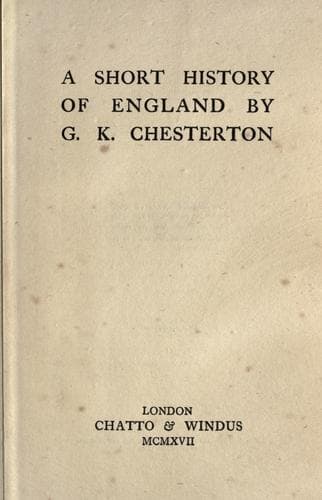
A Short History of EnglandChesterton, G. K. (Gilbert Keith)
History
A Short History of England
Chesterton, G. K. (Gilbert Keith)
Great Britain -- History
The name of Cobbett is very important here; indeed it is generally
ignored because it is important. Cobbett was the one man who saw the
tendency of the time as a whole, and challenged it as a whole;
consequently he went without support. It is a mark of our whole modern
history that the masses are kept quiet with a fight. They are kept quiet
by the fight because it is a sham-fight; thus most of us know by this
time that the Party System has been popular only in the same sense that
a football match is popular. The division in Cobbett's time was slightly
more sincere, but almost as superficial; it was a difference of
sentiment about externals which divided the old agricultural gentry of
the eighteenth century from the new mercantile gentry of the
nineteenth. Through the first half of the nineteenth century there were
some real disputes between the squire and the merchant. The merchant
became converted to the important economic thesis of Free Trade, and
accused the squire of starving the poor by dear bread to keep up his
agrarian privilege. Later the squire retorted not ineffectively by
accusing the merchant of brutalizing the poor by overworking them in his
factories to keep up his commercial success. The passing of the Factory
Acts was a confession of the cruelty that underlay the new industrial
experiments, just as the Repeal of the Corn Laws was a confession of the
comparative weakness and unpopularity of the squires, who had destroyed
the last remnants of any peasantry that might have defended the field
against the factory. These relatively real disputes would bring us to
the middle of the Victorian era. But long before the beginning of the
Victorian era, Cobbett had seen and said that the disputes were only
relatively real. Or rather he would have said, in his more robust
fashion, that they were not real at all. He would have said that the
agricultural pot and the industrial kettle were calling each other
black, when they had both been blackened in the same kitchen. And he
would have been substantially right; for the great industrial disciple
of the kettle, James Watt (who learnt from it the lesson of the steam
engine), was typical of the age in this, that he found the old Trade
Guilds too fallen, unfashionable and out of touch with the times to help
his discovery, so that he had recourse to the rich minority which had
warred on and weakened those Guilds since the Reformation. There was no
prosperous peasant's pot, such as Henry of Navarre invoked, to enter
into alliance with the kettle. In other words, there was in the strict
sense of the word no commonwealth, because wealth, though more and more
wealthy, was less and less common. Whether it be a credit or discredit,
industrial science and enterprise were in bulk a new experiment of the
old oligarchy; and the old oligarchy had always been ready for new
experiments--beginning with the Reformation. And it is characteristic of
Public-domain text, read in full here on John Shaqi.
Reviews
Reviews
No reviews yet
Be the first to share your thoughts on this work.
Elsewhere in the archive
Join the Discussion
Join the discussion
Sign in to leave a comment or review.
Sign InorCreate an account