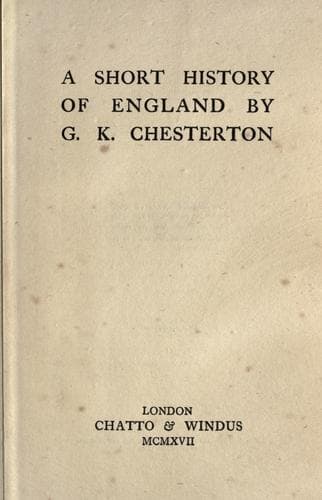
A Short History of EnglandChesterton, G. K. (Gilbert Keith)
History
A Short History of England
Chesterton, G. K. (Gilbert Keith)
Great Britain -- History
The only way to write a popular history, as we have already remarked,
would be to write it backwards. It would be to take common objects of
our own street and tell the tale of how each of them came to be in the
street at all. And for my immediate purpose it is really convenient to
take two objects we have known all our lives, as features of fashion or
respectability. One, which has grown rarer recently, is what we call a
top-hat; the other, which is still a customary formality, is a pair of
trousers. The history of these humorous objects really does give a clue
to what has happened in England for the last hundred years. It is not
necessary to be an aesthete in order to regard both objects as the
reverse of beautiful, as tested by what may be called the rational side
of beauty. The lines of human limbs can be beautiful, and so can the
lines of loose drapery, but not cylinders too loose to be the first and
too tight to be the second. Nor is a subtle sense of harmony needed to
see that while there are hundreds of differently proportioned hats, a
hat that actually grows larger towards the top is somewhat top-heavy.
But what is largely forgotten is this, that these two fantastic objects,
which now strike the eye as unconscious freaks, were originally
conscious freaks. Our ancestors, to do them justice, did not think them
casual or commonplace; they thought them, if not ridiculous, at least
rococo. The top-hat was the topmost point of a riot of Regency dandyism,
and bucks wore trousers while business men were still wearing
knee-breeches. It will not be fanciful to see a certain oriental touch
in trousers, which the later Romans also regarded as effeminately
oriental; it was an oriental touch found in many florid things of the
time--in Byron's poems or Brighton Pavilion. Now, the interesting point
is that for a whole serious century these instantaneous fantasies have
remained like fossils. In the carnival of the Regency a few fools got
into fancy dress, and we have all remained in fancy dress. At least, we
have remained in the dress, though we have lost the fancy.
Public-domain text, read in full here on John Shaqi.
Reviews
Reviews
No reviews yet
Be the first to share your thoughts on this work.
Elsewhere in the archive
Join the Discussion
Join the discussion
Sign in to leave a comment or review.
Sign InorCreate an account