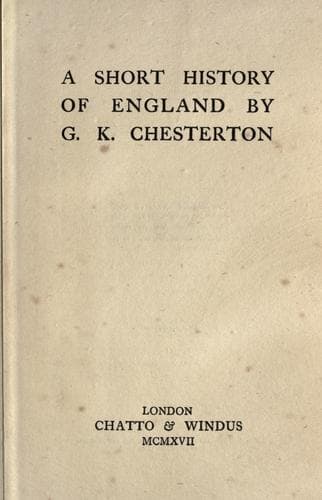
A Short History of EnglandChesterton, G. K. (Gilbert Keith)
History
A Short History of England
Chesterton, G. K. (Gilbert Keith)
Great Britain -- History
I say this is typical of the most important thing that happened in the
Victorian time. For the most important thing was that nothing happened.
The very fuss that was made about minor modifications brings into relief
the rigidity with which the main lines of social life were left as they
were at the French Revolution. We talk of the French Revolution as
something that changed the world; but its most important relation to
England is that it did not change England. A student of our history is
concerned rather with the effect it did not have than the effect it
did. If it be a splendid fate to have survived the Flood, the English
oligarchy had that added splendour. But even for the countries in which
the Revolution was a convulsion, it was the last convulsion--until that
which shakes the world to-day. It gave their character to all the
commonwealths, which all talked about progress, and were occupied in
marking time. Frenchmen, under all superficial reactions, remained
republican in spirit, as they had been when they first wore top-hats.
Englishmen, under all superficial reforms, remained oligarchical in
spirit, as they had been when they first wore trousers. Only one power
might be said to be growing, and that in a plodding and prosaic
fashion--the power in the North-East whose name was Prussia. And the
English were more and more learning that this growth need cause them no
alarm, since the North Germans were their cousins in blood and their
brothers in spirit.
The first thing to note, then, about the nineteenth century is that
Europe remained herself as compared with the Europe of the great war,
and that England especially remained herself as compared even with the
rest of Europe. Granted this, we may give their proper importance to the
cautious internal changes in this country, the small conscious and the
large unconscious changes. Most of the conscious ones were much upon the
model of an early one, the great Reform Bill of 1832, and can be
considered in the light of it. First, from the standpoint of most real
reformers, the chief thing about the Reform Bill was that it did not
reform. It had a huge tide of popular enthusiasm behind it, which wholly
disappeared when the people found themselves in front of it. It
enfranchised large masses of the middle classes; it disfranchised very
definite bodies of the working classes; and it so struck the balance
between the conservative and the dangerous elements in the commonwealth
that the governing class was rather stronger than before. The date,
however, is important, not at all because it was the beginning of
democracy, but because it was the beginning of the best way ever
discovered of evading and postponing democracy. Here enters the
homoeopathic treatment of revolution, since so often successful. Well
into the next generation Disraeli, the brilliant Jewish adventurer who
was the symbol of the English aristocracy being no longer genuine,
Public-domain text, read in full here on John Shaqi.
Reviews
Reviews
No reviews yet
Be the first to share your thoughts on this work.
Elsewhere in the archive
Join the Discussion
Join the discussion
Sign in to leave a comment or review.
Sign InorCreate an account