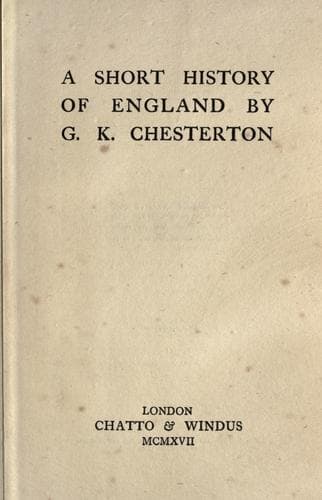
A Short History of EnglandChesterton, G. K. (Gilbert Keith)
History
A Short History of England
Chesterton, G. K. (Gilbert Keith)
Great Britain -- History
Anyhow, the unconscious nineteenth-century movement, so slow that it
seems stationary, was altogether in this direction, of which workhouse
philanthropy is the type. Nevertheless, it had one national institution
to combat and overcome; one institution all the more intensely national
because it was not official, and in a sense not even political. The
modern Trade Union was the inspiration and creation of the English; it
is still largely known throughout Europe by its English name. It was the
English expression of the European effort to resist the tendency of
Capitalism to reach its natural culmination in slavery. In this it has
an almost weird psychological interest, for it is a return to the past
by men ignorant of the past, like the subconscious action of some man
who has lost his memory. We say that history repeats itself, and it is
even more interesting when it unconsciously repeats itself. No man on
earth is kept so ignorant of the Middle Ages as the British workman,
except perhaps the British business man who employs him. Yet all who
know even a little of the Middle Ages can see that the modern Trade
Union is a groping for the ancient Guild. It is true that those who
look to the Trade Union, and even those clear-sighted enough to call it
the Guild, are often without the faintest tinge of mediaeval mysticism,
or even of mediaeval morality. But this fact is itself the most striking
and even staggering tribute to mediaeval morality. It has all the
clinching logic of coincidence. If large numbers of the most hard-headed
atheists had evolved, out of their own inner consciousness, the notion
that a number of bachelors or spinsters ought to live together in
celibate groups for the good of the poor, or the observation of certain
hours and offices, it would be a very strong point in favour of the
monasteries. It would be all the stronger if the atheists had never
heard of monasteries; it would be strongest of all if they hated the
very name of monasteries. And it is all the stronger because the man who
puts his trust in Trades Unions does not call himself a Catholic or even
a Christian, if he does call himself a Guild Socialist.
Public-domain text, read in full here on John Shaqi.
Reviews
Reviews
No reviews yet
Be the first to share your thoughts on this work.
Elsewhere in the archive
Join the Discussion
Join the discussion
Sign in to leave a comment or review.
Sign InorCreate an account