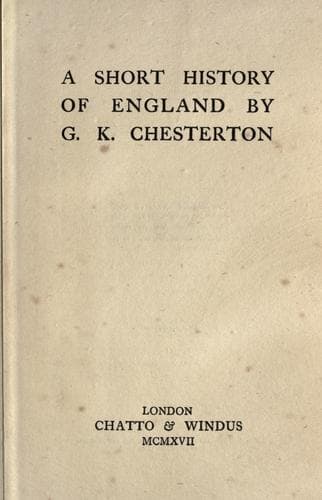
A Short History of EnglandChesterton, G. K. (Gilbert Keith)
History
A Short History of England
Chesterton, G. K. (Gilbert Keith)
Great Britain -- History
no mob has ever dared to storm it, and it never fell.
The New Poor Law was indeed not wholly new in the sense that it was the
culmination and clear enunciation of a principle foreshadowed in the
earlier Poor Law of Elizabeth, which was one of the many anti-popular
effects of the Great Pillage. When the monasteries were swept away and
the mediaeval system of hospitality destroyed, tramps and beggars became
a problem, the solution of which has always tended towards slavery, even
when the question of slavery has been cleared of the irrelevant question
of cruelty. It is obvious that a desperate man might find Mr. Bumble and
the Board of Guardians less cruel than cold weather and the bare
ground--even if he were allowed to sleep on the ground, which (by a
veritable nightmare of nonsense and injustice) he is not. He is actually
punished for sleeping under a bush on the specific and stated ground
that he cannot afford a bed. It is obvious, however, that he may find
his best physical good by going into the workhouse, as he often found it
in pagan times by selling himself into slavery. The point is that the
solution remains servile, even when Mr. Bumble and the Board of
Guardians ceased to be in a common sense cruel. The pagan might have the
luck to sell himself to a kind master. The principle of the New Poor
Law, which has so far proved permanent in our society, is that the man
lost all his civic rights and lost them solely through poverty. There is
a touch of irony, though hardly of mere hypocrisy, in the fact that the
Parliament which effected this reform had just been abolishing black
slavery by buying out the slave-owners in the British colonies. The
slave-owners were bought out at a price big enough to be called
blackmail; but it would be misunderstanding the national mentality to
deny the sincerity of the sentiment. Wilberforce represented in this the
real wave of Wesleyan religion which had made a humane reaction against
Calvinism, and was in no mean sense philanthropic. But there is
something romantic in the English mind which can always see what is
remote. It is the strongest example of what men lose by being
long-sighted. It is fair to say that they gain many things also, the
poems that are like adventures and the adventures that are like poems.
It is a national savour, and therefore in itself neither good nor evil;
and it depends on the application whether we find a scriptural text for
it in the wish to take the wings of the morning and abide in the
uttermost parts of the sea, or merely in the saying that the eyes of a
fool are in the ends of the earth.
Public-domain text, read in full here on John Shaqi.
Reviews
Reviews
No reviews yet
Be the first to share your thoughts on this work.
Elsewhere in the archive
Join the Discussion
Join the discussion
Sign in to leave a comment or review.
Sign InorCreate an account