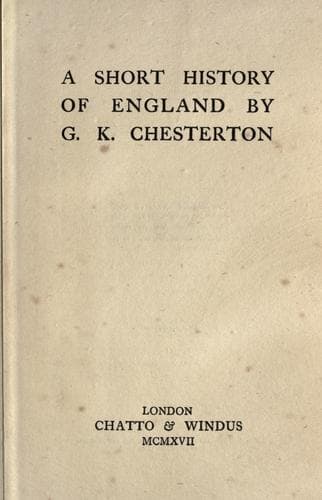
A Short History of EnglandChesterton, G. K. (Gilbert Keith)
History
A Short History of England
Chesterton, G. K. (Gilbert Keith)
Great Britain -- History
And then a day came, and if we were wise, we thanked God that we had
failed. Education, if it had ever really been in question, would
doubtless have been a noble gift; education in the sense of the central
tradition of history, with its freedom, its family honour, its chivalry
which is the flower of Christendom. But what would our populace, in our
epoch, have actually learned if they had learned all that our schools
and universities had to teach? That England was but a little branch on a
large Teutonic tree; that an unfathomable spiritual sympathy,
all-encircling like the sea, had always made us the natural allies of
the great folk by the flowing Rhine; that all light came from Luther and
Lutheran Germany, whose science was still purging Christianity of its
Greek and Roman accretions; that Germany was a forest fated to grow;
that France was a dung-heap fated to decay--a dung-heap with a crowing
cock on it. What would the ladder of education have led to, except a
platform on which a posturing professor proved that a cousin german was
the same as a German cousin? What would the guttersnipe have learnt as a
graduate, except to embrace a Saxon because he was the other half of an
Anglo-Saxon? The day came, and the ignorant fellow found he had other
things to learn. And he was quicker than his educated countrymen, for
he had nothing to unlearn.
He in whose honour all had been said and sung stirred, and stepped
across the border of Belgium. Then were spread out before men's eyes all
the beauties of his culture and all the benefits of his organization;
then we beheld under a lifting daybreak what light we had followed and
after what image we had laboured to refashion ourselves. Nor in any
story of mankind has the irony of God chosen the foolish things so
catastrophically to confound the wise. For the common crowd of poor and
ignorant Englishmen, because they only knew that they were Englishmen,
burst through the filthy cobwebs of four hundred years and stood where
their fathers stood when they knew that they were Christian men. The
English poor, broken in every revolt, bullied by every fashion, long
despoiled of property, and now being despoiled of liberty, entered
history with a noise of trumpets, and turned themselves in two years
into one of the iron armies of the world. And when the critic of
politics and literature, feeling that this war is after all heroic,
looks around him to find the hero, he can point to nothing but a mob.
XVIII
CONCLUSION
Public-domain text, read in full here on John Shaqi.
Reviews
Reviews
No reviews yet
Be the first to share your thoughts on this work.
Elsewhere in the archive
Join the Discussion
Join the discussion
Sign in to leave a comment or review.
Sign InorCreate an account