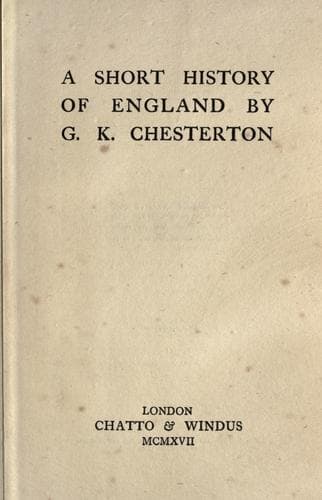
A Short History of EnglandChesterton, G. K. (Gilbert Keith)
History
A Short History of England
Chesterton, G. K. (Gilbert Keith)
Great Britain -- History
In so small a book on so large a matter, finished hastily enough amid
the necessities of an enormous national crisis, it would be absurd to
pretend to have achieved proportion; but I will confess to some attempt
to correct a disproportion. We talk of historical perspective, but I
rather fancy there is too much perspective in history; for perspective
makes a giant a pigmy and a pigmy a giant. The past is a giant
foreshortened with his feet towards us; and sometimes the feet are of
clay. We see too much merely the sunset of the Middle Ages, even when we
admire its colours; and the study of a man like Napoleon is too often
that of "The Last Phase." So there is a spirit that thinks it reasonable
to deal in detail with Old Sarum, and would think it ridiculous to deal
in detail with the Use of Sarum; or which erects in Kensington Gardens a
golden monument to Albert larger than anybody has ever erected to
Alfred. English history is misread especially, I think, because the
crisis is missed. It is usually put about the period of the Stuarts; and
many of the memorials of our past seem to suffer from the same
visitation as the memorial of Mr. Dick. But though the story of the
Stuarts was a tragedy, I think it was also an epilogue.
I make the guess, for it can be no more, that the change really came
with the fall of Richard II., following on his failure to use mediaeval
despotism in the interests of mediaeval democracy. England, like the
other nations of Christendom, had been created not so much by the death
of the ancient civilization as by its escape from death, or by its
refusal to die. Mediaeval civilization had arisen out of the resistance
to the barbarians, to the naked barbarism from the North and the more
subtle barbarism from the East. It increased in liberties and local
government under kings who controlled the wider things of war and
taxation; and in the peasant war of the fourteenth century in England,
the king and the populace came for a moment into conscious alliance.
They both found that a third thing was already too strong for them. That
third thing was the aristocracy; and it captured and called itself the
Parliament. The House of Commons, as its name implies, had primarily
consisted of plain men summoned by the King like jurymen; but it soon
became a very special jury. It became, for good or evil, a great organ
of government, surviving the Church, the monarchy and the mob; it did
many great and not a few good things. It created what we call the
British Empire; it created something which was really far more
valuable, a new and natural sort of aristocracy, more humane and even
humanitarian than most of the aristocracies of the world. It had
sufficient sense of the instincts of the people, at least until lately,
to respect the liberty and especially the laughter that had become
almost the religion of the race. But in doing all this, it deliberately
did two other things, which it thought a natural part of its policy; it
Public-domain text, read in full here on John Shaqi.
Reviews
Reviews
No reviews yet
Be the first to share your thoughts on this work.
Elsewhere in the archive
Join the Discussion
Join the discussion
Sign in to leave a comment or review.
Sign InorCreate an account