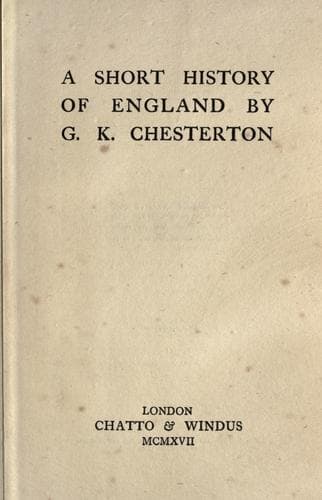
A Short History of EnglandChesterton, G. K. (Gilbert Keith)
History
A Short History of England
Chesterton, G. K. (Gilbert Keith)
Great Britain -- History
took the side of the Protestants, and then (partly as a consequence) it
took the side of the Germans. Until very lately most intelligent
Englishmen were quite honestly convinced that in both it was taking the
side of progress against decay. The question which many of them are now
inevitably asking themselves, and would ask whether I asked it or no, is
whether it did not rather take the side of barbarism against
civilization.
At least, if there be anything valid in my own vision of these things,
we have returned to an origin and we are back in the war with the
barbarians. It falls as naturally for me that the Englishman and the
Frenchman should be on the same side as that Alfred and Abbo should be
on the same side, in that black century when the barbarians wasted
Wessex and besieged Paris. But there are now, perhaps, less certain
tests of the spiritual as distinct from the material victory of
civilization. Ideas are more mixed, are complicated by fine shades or
covered by fine names. And whether the retreating savage leaves behind
him the soul of savagery, like a sickness in the air, I myself should
judge primarily by one political and moral test. The soul of savagery is
slavery. Under all its mask of machinery and instruction, the German
regimentation of the poor was the relapse of barbarians into slavery. I
can see no escape from it for ourselves in the ruts of our present
reforms, but only by doing what the mediaevals did after the other
barbarian defeat: beginning, by guilds and small independent groups,
gradually to restore the personal property of the poor and the personal
freedom of the family. If the English really attempt that, the English
have at least shown in the war, to any one who doubted it, that they
have not lost the courage and capacity of their fathers, and can carry
it through if they will. If they do not do so, if they continue to move
only with the dead momentum of the social discipline which we learnt
from Germany, there is nothing before us but what Mr. Belloc, the
discoverer of this great sociological drift, has called the Servile
State. And there are moods in which a man, considering that conclusion
of our story, is half inclined to wish that the wave of Teutonic
barbarism had washed out us and our armies together; and that the world
should never know anything more of the last of the English, except that
they died for liberty.
THE END
PRINTED IN ENGLAND BY WILLIAM CLOWES AND SONS, LIMITED,
LONDON AND BECCLES.
[Illustration: Publisher's logo]
Public-domain text, read in full here on John Shaqi.
Reviews
Reviews
No reviews yet
Be the first to share your thoughts on this work.
Elsewhere in the archive
Join the Discussion
Join the discussion
Sign in to leave a comment or review.
Sign InorCreate an account