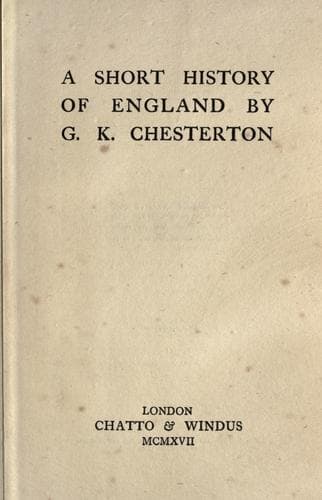
A Short History of EnglandChesterton, G. K. (Gilbert Keith)
History
A Short History of England
Chesterton, G. K. (Gilbert Keith)
Great Britain -- History
The other notable element was this: that when the produce of the land
began by custom to be cut up and only partially transmitted to the lord,
the remainder was generally subdivided into two types of property. One
the serfs enjoyed severally, in private patches, while the other they
enjoyed in common, and generally in common with the lord. Thus arose the
momentously important mediaeval institutions of the Common Land, owned
side by side with private land. It was an alternative and a refuge. The
mediaevals, except when they were monks, were none of them Communists;
but they were all, as it were, potential Communists. It is typical of
the dark and dehumanized picture now drawn of the period that our
romances constantly describe a broken man as falling back on the forests
and the outlaw's den, but never describe him as falling back on the
common land, which was a much more common incident. Mediaevalism
believed in mending its broken men; and as the idea existed in the
communal life for monks, it existed in the communal land for peasants.
It was their great green hospital, their free and airy workhouse. A
Common was not a naked and negative thing like the scrub or heath we
call a Common on the edges of the suburbs. It was a reserve of wealth
like a reserve of grain in a barn; it was deliberately kept back as a
balance, as we talk of a balance at the bank. Now these provisions for a
healthier distribution of property would by themselves show any man of
imagination that a real moral effort had been made towards social
justice; that it could not have been mere evolutionary accident that
slowly turned the slave into a serf, and the serf into a peasant
proprietor. But if anybody still thinks that mere blind luck, without
any groping for the light, had somehow brought about the peasant
condition in place of the agrarian slave estate, he has only to turn to
what was happening in all the other callings and affairs of humanity.
Then he will cease to doubt. For he will find the same mediaeval men busy
upon a social scheme which points as plainly in effect to pity and a
craving for equality. And it is a system which could no more be produced
by accident than one of their cathedrals could be built by an
earthquake.
Public-domain text, read in full here on John Shaqi.
Reviews
Reviews
No reviews yet
Be the first to share your thoughts on this work.
Join the Discussion
Join the discussion
Sign in to leave a comment or review.
Sign InorCreate an account