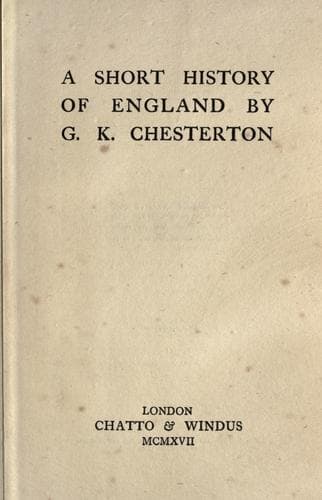
A Short History of EnglandChesterton, G. K. (Gilbert Keith)
History
A Short History of England
Chesterton, G. K. (Gilbert Keith)
Great Britain -- History
Pagan slavery had slowly perished, not so much by decaying as by
developing into something better. In one sense it did not die, but
rather came to life. The slave-owner was like a man who should set up a
row of sticks for a fence, and then find they had struck root and were
budding into small trees. They would be at once more valuable and less
manageable, especially less portable; and such a difference between a
stick and a tree was precisely the difference between a slave and a
serf--or even the free peasant which the serf seemed rapidly tending to
become. It was, in the best sense of a battered phrase, a social
evolution, and it had the great evil of one. The evil was that while it
was essentially orderly, it was still literally lawless. That is, the
emancipation of the commons had already advanced very far, but it had
not yet advanced far enough to be embodied in a law. The custom was
"unwritten," like the British Constitution, and (like that evolutionary,
not to say evasive entity) could always be overridden by the rich, who
now drive their great coaches through Acts of Parliament. The new
peasant was still legally a slave, and was to learn it by one of those
turns of fortune which confound a foolish faith in the common sense of
unwritten constitutions. The French Wars gradually grew to be almost as
much of a scourge to England as they were to France. England was
despoiled by her own victories; luxury and poverty increased at the
extremes of society; and, by a process more proper to an ensuing
chapter, the balance of the better mediaevalism was lost. Finally, a
furious plague, called the Black Death, burst like a blast on the land,
thinning the population and throwing the work of the world into ruin.
There was a shortage of labour; a difficulty of getting luxuries; and
the great lords did what one would expect them to do. They became
lawyers, and upholders of the letter of the law. They appealed to a rule
already nearly obsolete, to drive the serf back to the more direct
servitude of the Dark Ages. They announced their decision to the people,
and the people rose in arms.
Public-domain text, read in full here on John Shaqi.
Reviews
Reviews
No reviews yet
Be the first to share your thoughts on this work.
Elsewhere in the archive
Join the Discussion
Join the discussion
Sign in to leave a comment or review.
Sign InorCreate an account