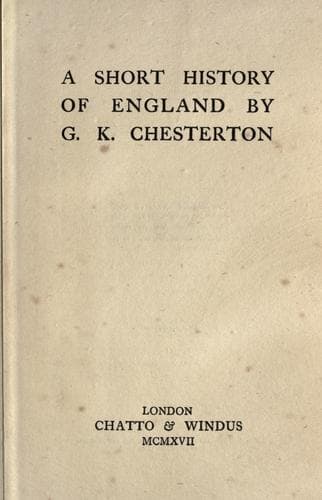
A Short History of EnglandChesterton, G. K. (Gilbert Keith)
History
A Short History of England
Chesterton, G. K. (Gilbert Keith)
Great Britain -- History
called the passage from bad Latin to good Greek. In our loose modern
debates they are lumped together; but Greek learning was the growth of
this time; there had always been a popular Latin, if a dog-Latin. It
would be nearer the truth to call the mediaevals bi-lingual than to call
their Latin a dead language. Greek never, of course, became so general a
possession; but for the man who got it, it is not too much to say that
he felt as if he were in the open air for the first time. Much of this
Greek spirit was reflected in More; its universality, its urbanity, its
balance of buoyant reason and cool curiosity. It is even probable that
he shared some of the excesses and errors of taste which inevitably
infected the splendid intellectualism of the reaction against the Middle
Ages; we can imagine him thinking gargoyles Gothic, in the sense of
barbaric, or even failing to be stirred, as Sydney was, by the trumpet
of "Chevy Chase." The wealth of the ancient heathen world, in wit,
loveliness, and civic heroism, had so recently been revealed to that
generation in its dazzling profusion and perfection, that it might seem
a trifle if they did here and there an injustice to the relics of the
Dark Ages. When, therefore, we look at the world with the eyes of More
we are looking from the widest windows of that time; looking over an
English landscape seen for the first time very equally, in the level
light of the sun at morning. For what he saw was England of the
Renascence; England passing from the mediaeval to the modern. Thus he
looked forth, and saw many things and said many things; they were all
worthy and many witty; but he noted one thing which is at once a
horrible fancy and a homely and practical fact. He who looked over that
landscape said: "Sheep are eating men."
Public-domain text, read in full here on John Shaqi.
Reviews
Reviews
No reviews yet
Be the first to share your thoughts on this work.
Elsewhere in the archive
Join the Discussion
Join the discussion
Sign in to leave a comment or review.
Sign InorCreate an account