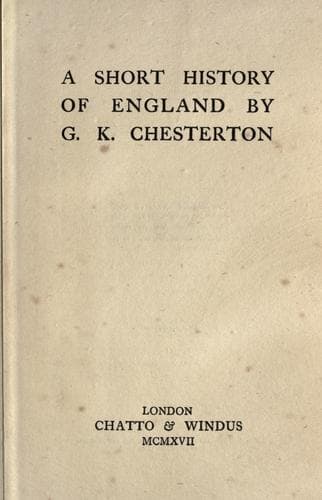
A Short History of EnglandChesterton, G. K. (Gilbert Keith)
History
A Short History of England
Chesterton, G. K. (Gilbert Keith)
Great Britain -- History
This singular summary of the great epoch of our emancipation and
enlightenment is not the fact usually put first in such very curt
historical accounts of it. It has nothing to do with the translation of
the Bible, or the character of Henry VIII., or the characters of Henry
VIII.'s wives, or the triangular debates between Henry and Luther and
the Pope. It was not Popish sheep who were eating Protestant men, or
_vice versa_; nor did Henry, at any period of his own brief and rather
bewildering papacy, have martyrs eaten by lambs as the heathen had them
eaten by lions. What was meant, of course, by this picturesque
expression, was that an intensive type of agriculture was giving way to
a very extensive type of pasture. Great spaces of England which had
hitherto been cut up into the commonwealth of a number of farmers were
being laid under the sovereignty of a solitary shepherd. The point has
been put, by a touch of epigram rather in the manner of More himself, by
Mr. J. Stephen, in a striking essay now, I think, only to be found in
the back files of _The New Witness_. He enunciated the paradox that the
very much admired individual, who made two blades of grass grow instead
of one, was a murderer. In the same article, Mr. Stephen traced the true
moral origins of this movement, which led to the growing of so much
grass and the murder, or at any rate the destruction, of so much
humanity. He traced it, and every true record of that transformation
traces it, to the growth of a new refinement, in a sense a more rational
refinement, in the governing class. The mediaeval lord had been, by
comparison, a coarse fellow; he had merely lived in the largest kind of
farm-house after the fashion of the largest kind of farmer. He drank
wine when he could, but he was quite ready to drink ale; and science had
not yet smoothed his paths with petrol. At a time later than this, one
of the greatest ladies of England writes to her husband that she cannot
come to him because her carriage horses are pulling the plough. In the
true Middle Ages the greatest men were even more rudely hampered, but
in the time of Henry VIII. the transformation was beginning. In the next
generation a phrase was common which is one of the keys of the time, and
is very much the key to these more ambitious territorial schemes. This
or that great lord was said to be "Italianate." It meant subtler shapes
of beauty, delicate and ductile glass, gold and silver not treated as
barbaric stones but rather as stems and wreaths of molten metal,
mirrors, cards and such trinkets bearing a load of beauty; it meant the
perfection of trifles. It was not, as in popular Gothic craftsmanship,
the almost unconscious touch of art upon all necessary things: rather it
was the pouring of the whole soul of passionately conscious art
especially into unnecessary things. Luxury was made alive with a soul.
We must remember this real thirst for beauty; for it is an
explanation--and an excuse.
Public-domain text, read in full here on John Shaqi.
Reviews
Reviews
No reviews yet
Be the first to share your thoughts on this work.
Elsewhere in the archive
Join the Discussion
Join the discussion
Sign in to leave a comment or review.
Sign InorCreate an account